What is Revedia? An Infographic Guide
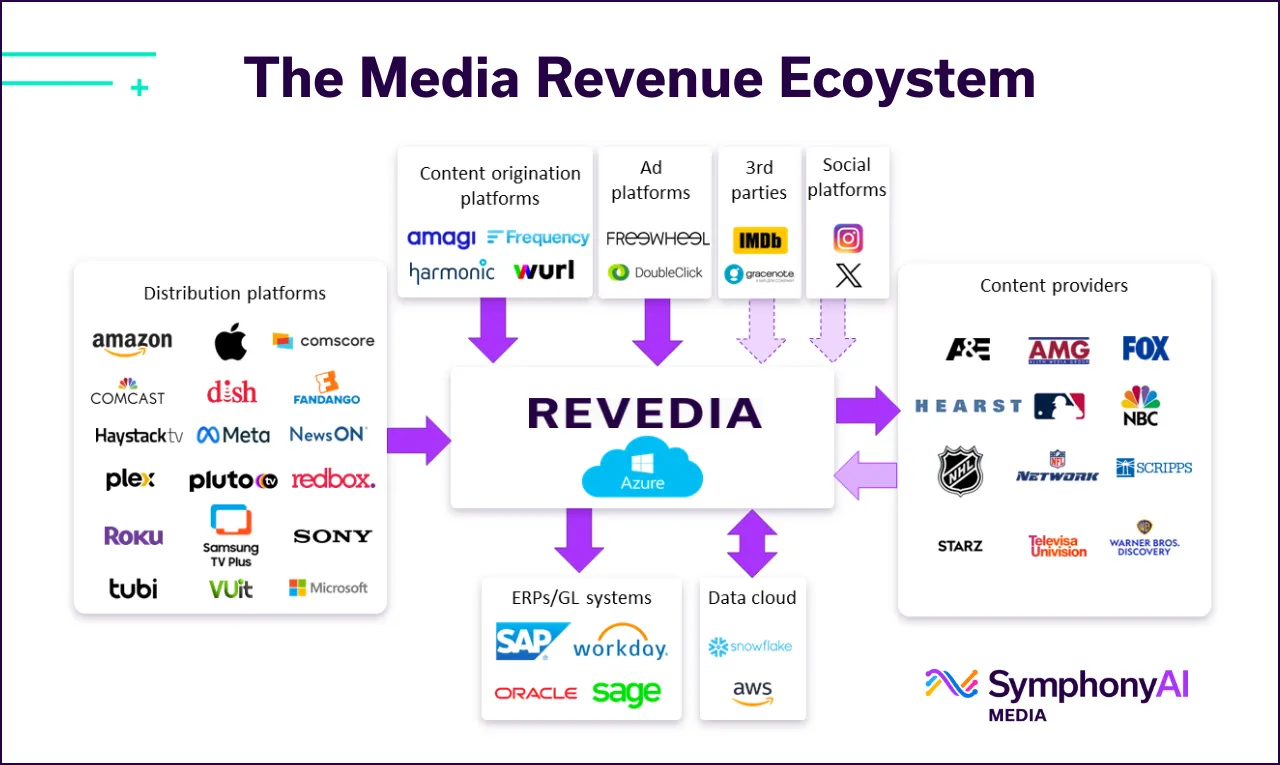
This post explains how the Revedia platform enables robust content revenue analytics, accelerates the flow of data intelligence, and interfaces with other data systems.
Revedia is a data intelligence platform that operates within the media revenue ecosystem – but what does that mean?
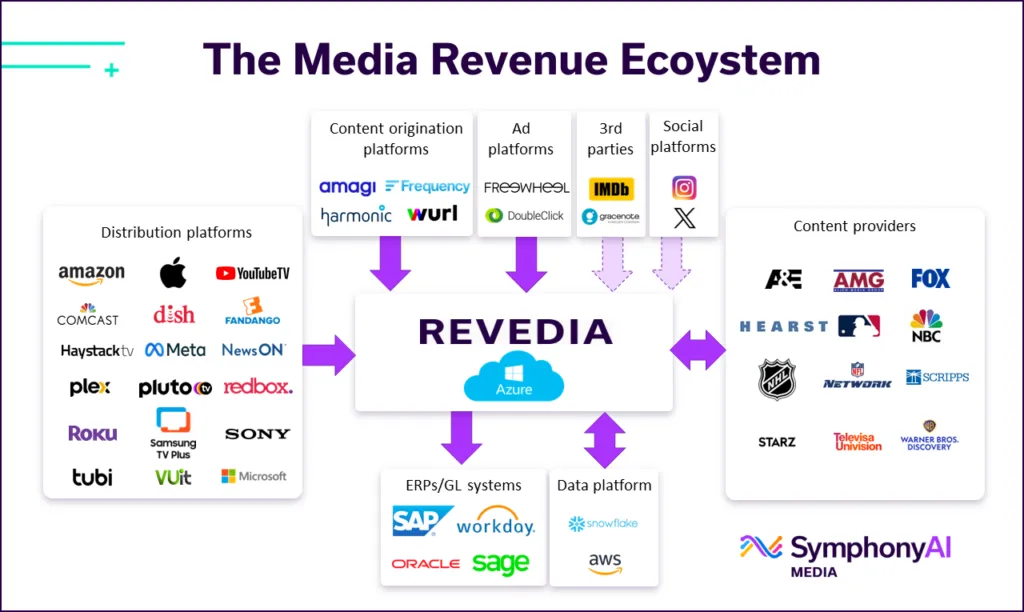
To help explain, we created the graphic below. It shows how content providers use Revedia as a source of truth for content revenue insight. To simplify Revedia’s technical capabilities, let’s examine three important jobs that the platform performs:
- Aggregating data from multiple sources
- Normalizing data (for consistent formats, labels, etc.)
- Analyzing data to answer questions and deliver insight
Companies also integrate Revedia with other systems – for example, cloud storage push/pull and sending output to downstream analytics tools.
Revedia solves data and revenue management challenges for content sellers
Companies monetizing content now embrace multiple distribution models, such as licensing to SVOD services and distributing to FAST channels. Whereas pay TV distributors have historically sent content sellers predictable monthly revenue reports containing standardized data sets, OTT data sharing practices differ drastically.
Today’s content sellers receive a dizzying array of data. Its format, frequency, quality, and quantity vary widely — depending on the platform and content licensing agreement in question.
Most content sellers distribute video assets to multiple OTT streaming services. Turning the mix of data they receive into actionable analytics is time-consuming, complicated, and expensive.
Revedia helps content sellers automate the process of gathering data from distribution partners (and other sources) into a single source of truth. It enables valuable insight that helps streamline workflows and optimize content production and distribution decisions.
Revedia aggregates data from multiple sources
Revedia sits at the center of a distributed monetization ecosystem that involves multiple players.
- Content sellers – Revedia not only streamlines the management of content revenue data that content sellers receive, but also centralizes licensing agreements to automate deal flow, payment reconciliation, and compliance auditing.
- Distribution platforms/services – Revedia centralizes the data that content sellers receive from both linear and OTT distribution partners into a single source of truth. Data sets may include content performance, audience engagement, revenue, and more.
- Content origination platforms – Revedia can integrate with the growing number of platforms that content sellers use to launch, manage, distribute, and white-label streaming services (particularly FAST).
- Ad platforms – Revedia can ingest and normalize advertising revenue data in order to provide content sellers with insight across multiple platforms and enable comparative analytics for key metrics such as impressions.
- Third parties – Revedia is designed to accommodate the modern media tech stack, which encompasses everything from payments and transactions to data warehouses. Our always-evolving capabilities enable smooth integration and deeper insight from combined data sets.
Meet the Revedia Universal Schema
We call our proprietary data framework the “Revedia Universal Schema” (or RUS). Essentially, it maps the wildly different data fields seen throughout the industry into a standardized format.
Working with thousands of media companies since Back to the Future was released, we’ve seen virtually every data point and report in the industry. That experience provides the groundwork for our schema, and we never stop evolving to stay ahead of the latest changes.
It adds up to a product that automatically ingests and formats data in a matter of seconds, whether it comes from Amazon, Samsung TV Plus, Tubi, or elsewhere.
Analyzing media data with Revedia
Once Revedia converts data into a format that’s easy on machines and humans alike, users leverage its built-in capabilities to automate multiple workflows such as performance analysis, revenue management, agreement management, and reporting. Revedia makes it faster, easier, and cheaper for content sellers to:
- Automatically calculate complex royalty rates
- Analyze content performance to optimize investment and distribution
- Perform revenue adjustments based on distributor data sets
- Correctly apply payments to the appropriate services, channels, etc.
- Reconcile distributor payments with licensing agreement terms
- Automatically detect revenue share payment anomalies
- Properly accrue and/or forecast anticipated distributor content revenue
Revedia pushes media data to multiple destinations
In addition to data ingest, normalization, and analysis, Revedia supports data import/export and integration with critical business systems.
- ERP & GL Systems – Enterprise content providers use Enterprise Resource Planning (ERP) aka General Ledger (GL) systems to track and manage data related to finance and accounting, human resources, materials management, payroll, taxes, CRM, and other resources. Revedia can act as a sub-ledger feeding in revenue data from the company’s media licensing/distribution activities.
- Data Platforms – Revedia offers standard and custom integrations enabling customers to import or export media data from data lakes and cloud-based data storage services like Snowflake and Amazon S3.
- Analytics tools – Revedia’s universal schema makes it easy to integrate other systems (including business intelligence, analytics, and data visualization tools) by exporting well-structured data to another location or server.
Streamline your media workflows with Revedia
With the ability to aggregate and normalize media data from multiple sources, analyze revenue data to accelerate insights, and export data to downstream analytics, data storage, and ERP/GL systems, Revedia connects the media revenue ecosystem like never before.
Teams that use Revedia are rapidly accelerating workflows, improving outcomes, and reducing overhead. Ready to join their ranks? Get a demo.