Payment Fraud

Low latency payment fraud detection and prevention

Seamlessly integrate AI-powered detection into your payment ecosystem stopping criminals in real-time and preventing fraud at the source
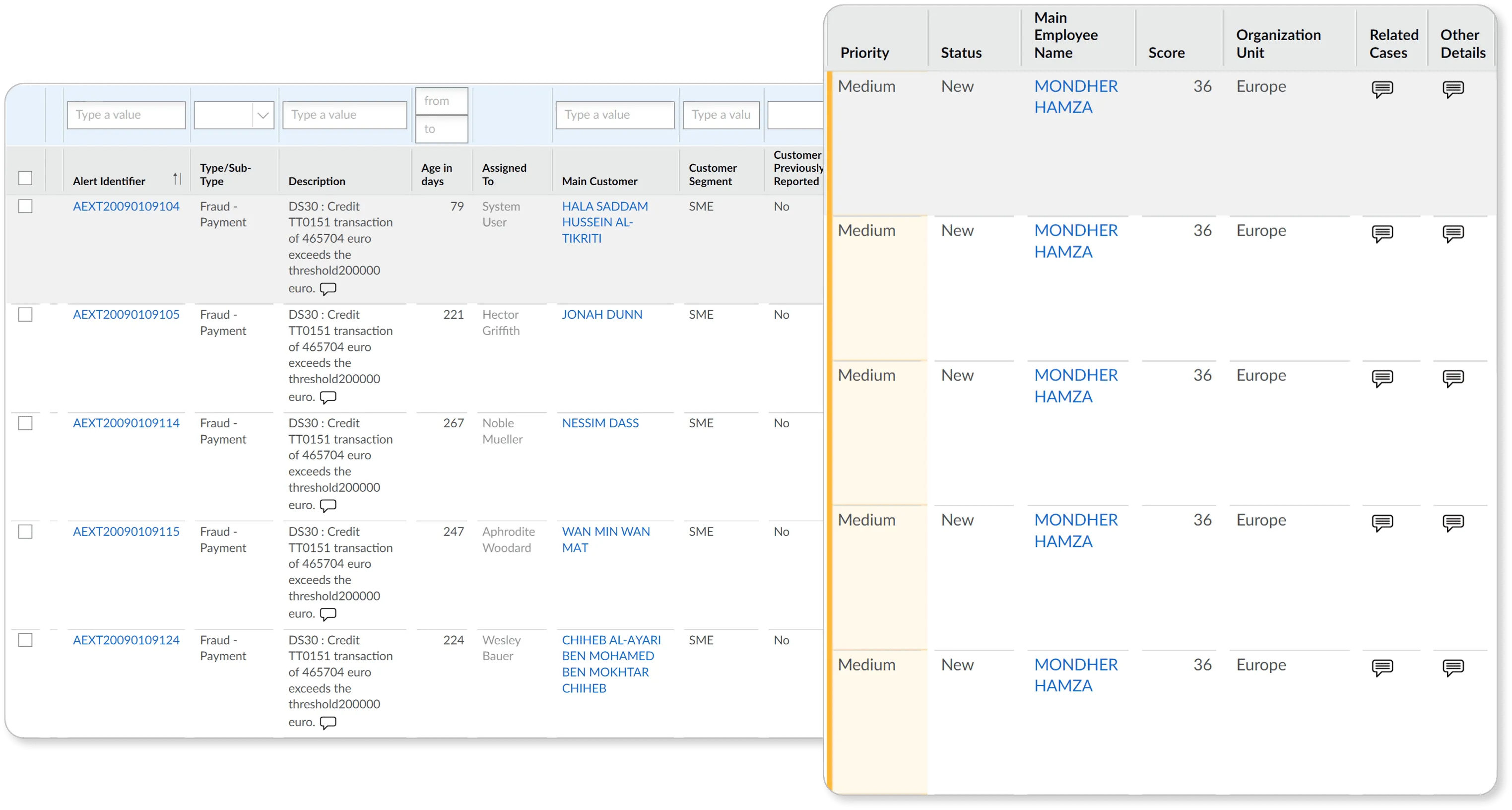

Table showing fraud payment alerts with columns for alert identifier, type, description, age in days, assigned to, main customer, customer segment, and previous report status; details show credit transactions of 465704 euros exceeding threshold of 2,000,000 euros, assigned to different users with medium priority, status new, employee name Mondher Hamza, score 36, organization unit Europe, and comment icons under related cases and other details.
Man sitting on a grey couch in a modern office using a smartphone and holding a credit card, with a laptop and glasses on the table in front of him.
Protecting customers from fraud with advanced behavioral intelligence

Sophisticated fraud schemes are evolving at an alarming rate. Is your financial institution able to stay one step ahead with advanced behavioral intelligence? Watch our insightful 25-minute webinar where industry leaders from SymphonyAI and ThreatMark reveal how behavioral intelligence and AI are transforming the fight against financial fraud.

A large translucent pale blue gradient circle on the right side fading into white.
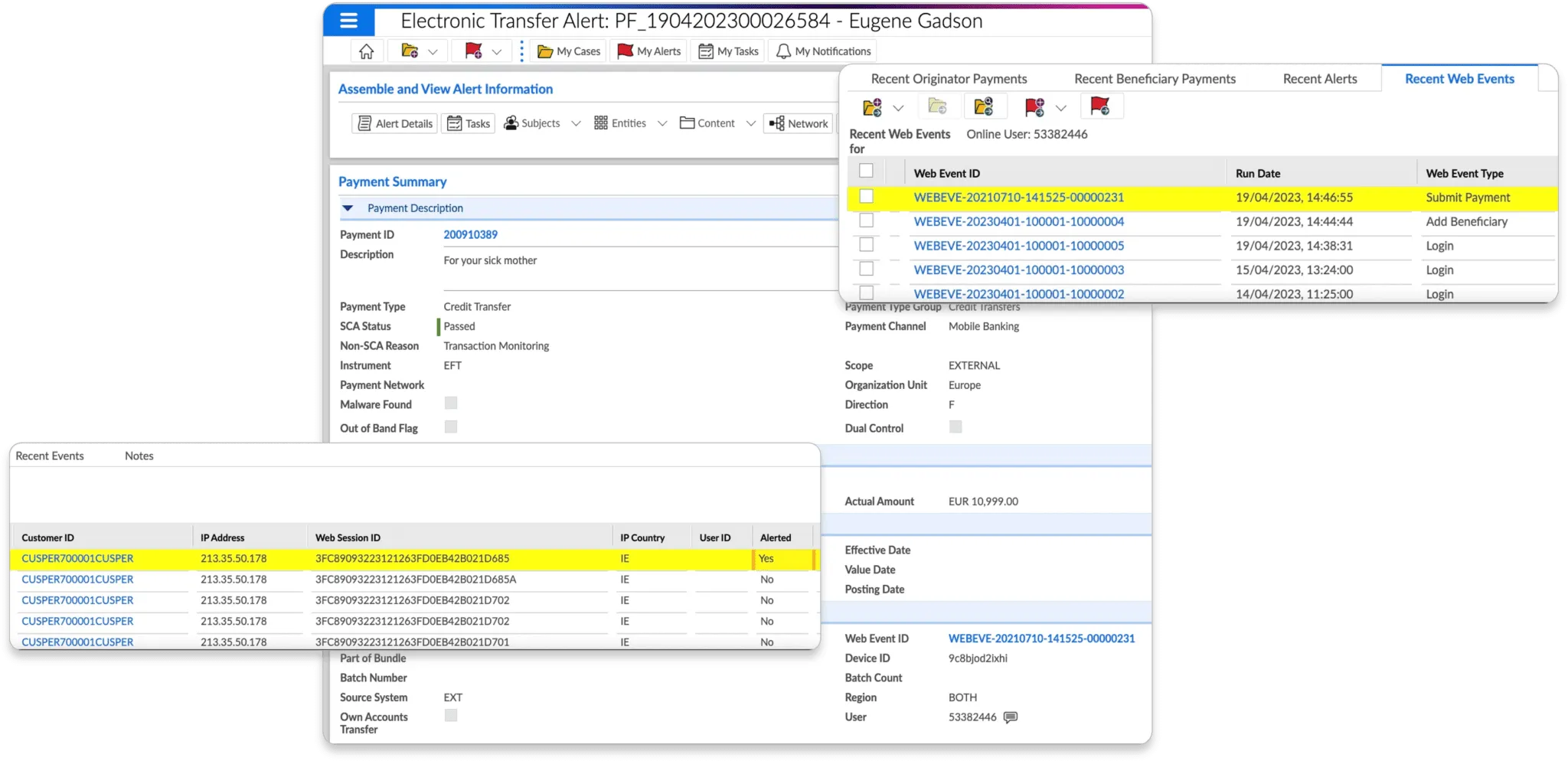
Screenshot of an electronic transfer alert for Eugene Gadson, showing payment details for payment ID 200910389 described as "For your sick mother" with payment type as credit transfer and status passed. It includes sections with recent web events listing web event IDs, run dates, and types such as Submit Payment and Login, with one highlighted event. Another section shows recent events with customer ID, IP address, web session ID, IP country, user ID, and alert status, with one row highlighted indicating an alert. The actual amount is EUR 10,999.00, and other audit details and timestamps are visible.

Intelligently evaluate in-flight payments to reduce fraud losses

Enable low latency interdiction on payments by evaluating transactions with advanced AI-driven fraud models and scenarios.
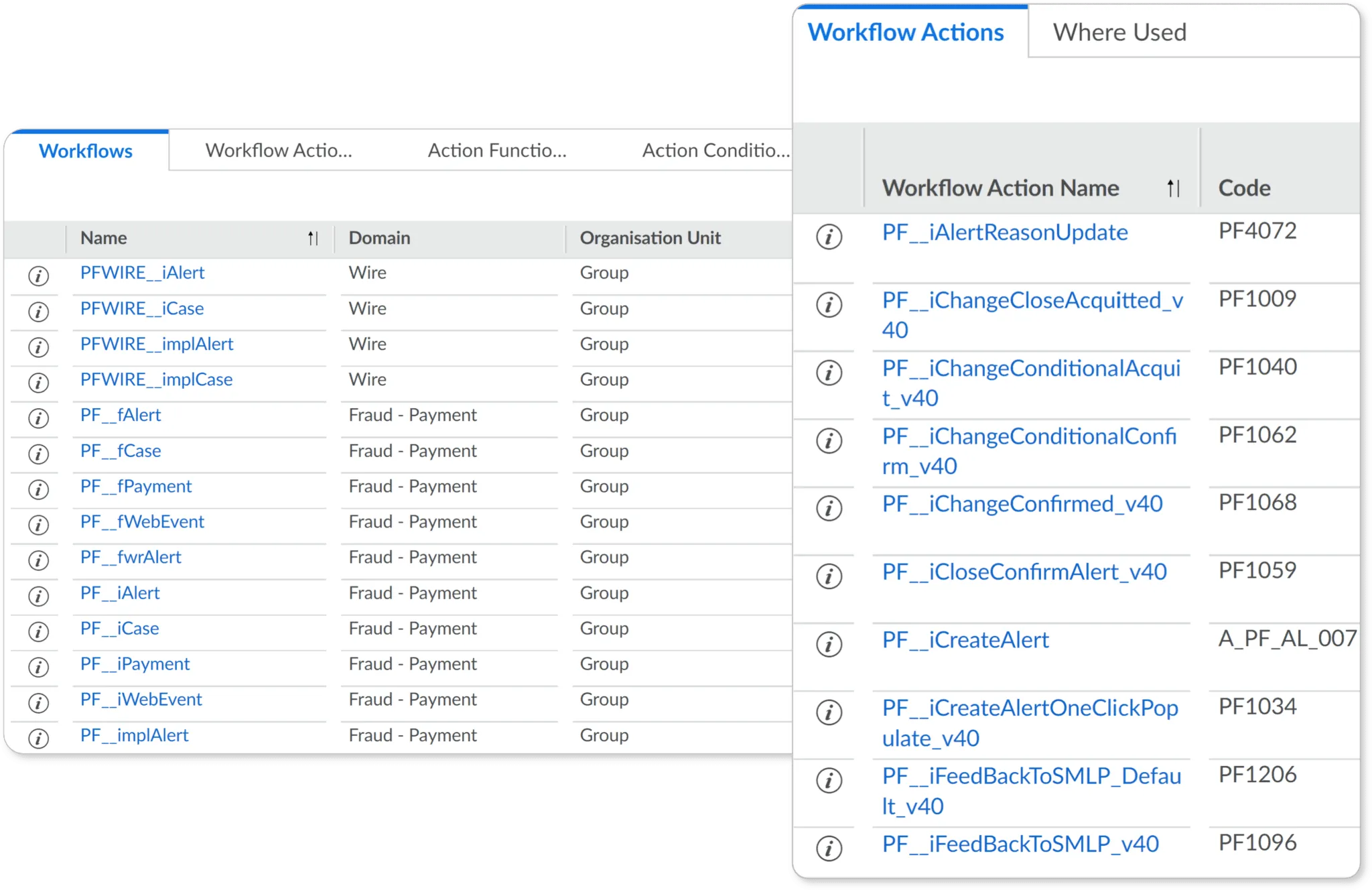
Two adjacent tabular lists from a software interface. The left table lists workflows by name, domain, and organization unit, mostly related to Wire and Fraud - Payment domains, all under Group units. The right table lists workflow actions, showing action names and corresponding codes such as PF4072, PF1009, and A_PF_AL_007, with action names mostly starting with 'PF__i'.

Enhance investigations and reduce false positives by 55%

Connect payment fraud risk signals across multiple channels and provide investigators with all risk event information in one place for faster, more effective risk evaluation.
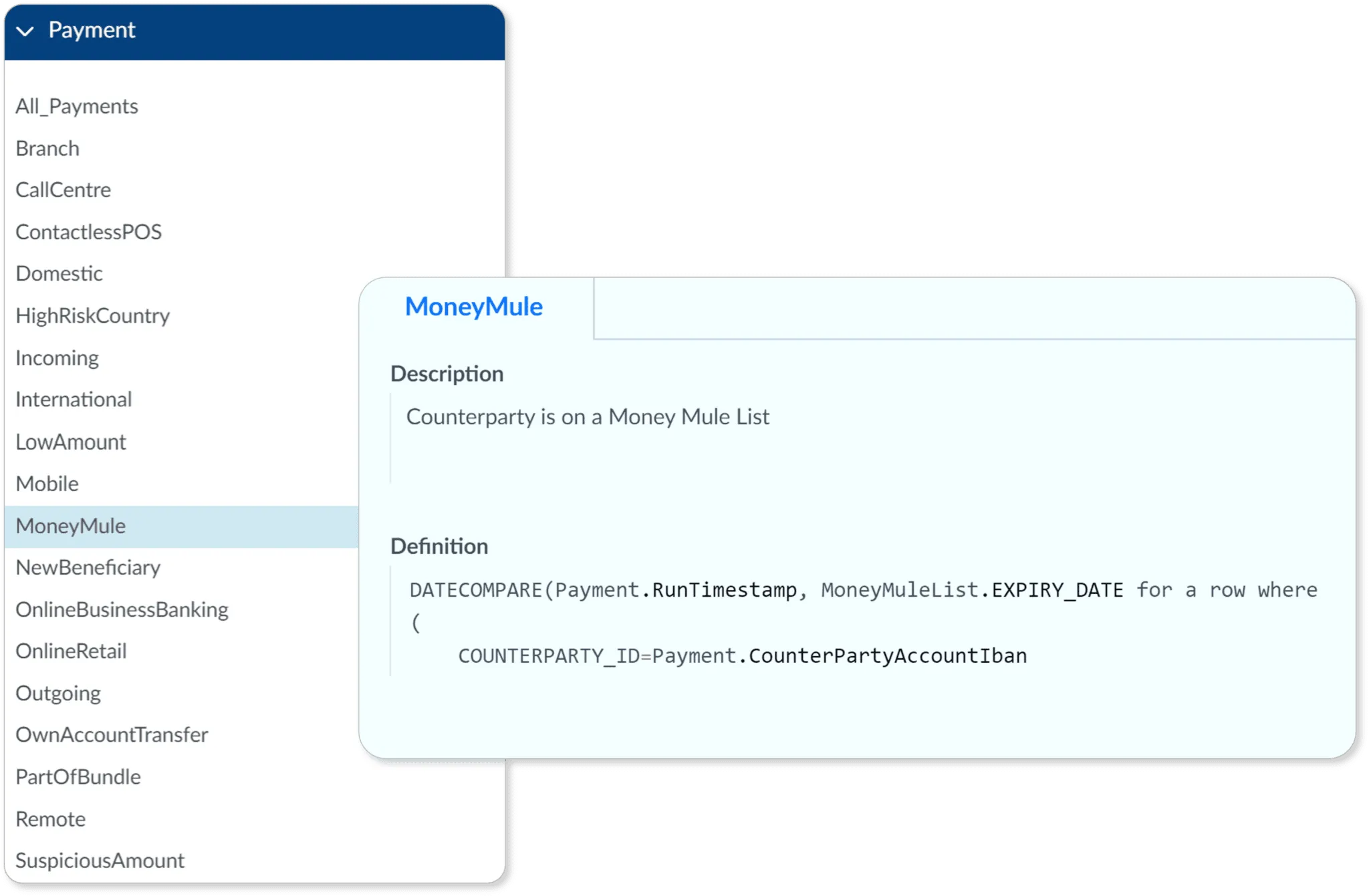
Screenshot of a dropdown menu labeled 'Payment' with various options like All_Payments, Branch, CallCentre, and MoneyMule highlighted. On the right, a detailed explanation panel for 'MoneyMule' shows the description stating 'Counterparty is on a Money Mule List' and a partial definition in code format comparing payment timestamp with MoneyMuleList expiry date and matching counterparty ID with payment's counterparty account IBAN.

Monitor evolving behavior and increase payment fraud detection by 50%

Continually monitor customer behavior and compare with pre-defined risk indicators and AI-powered models to identify new threats.
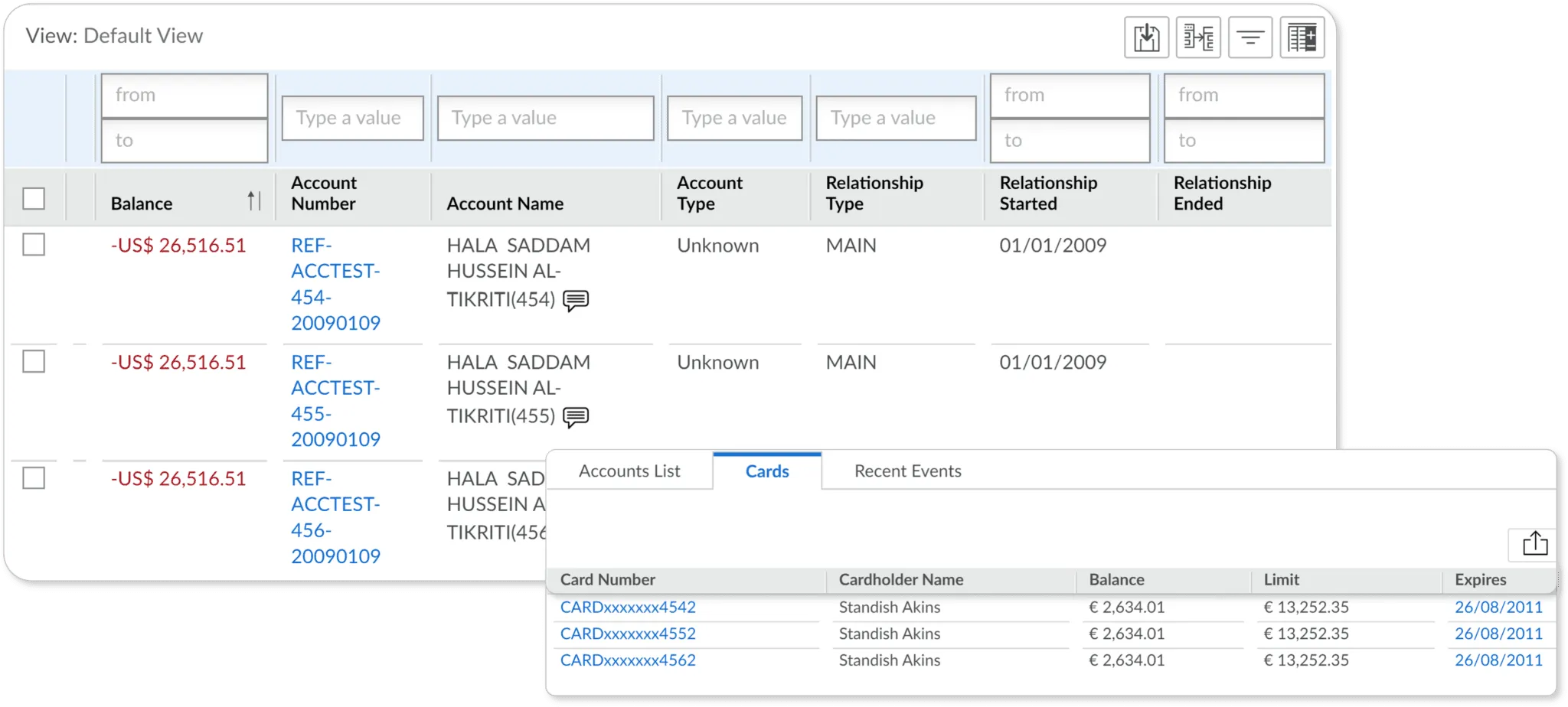
Two overlaid tables showing account and card information: the top table lists three accounts with negative balances of US$ 26,516.51 each, account numbers REF-ACCTEST-454-20090109, REF-ACCTEST-455-20090109, and REF-ACCTEST-456-20090109, account names HALA SADDAM HUSSEIN AL-TIKRITI(454/455/456), account type Unknown, relationship type MAIN, relationship started 01/01/2009, and no relationship ended date. The bottom table, under the 'Cards' tab, lists three card numbers ending 4542, 4552, 4562, all with cardholder name Standish Akins, a balance of €2,634.01, limit €13,252.35, and expiration date 26/08/2011.

Limitlessly scale and deploy enterprise-wide in just 12 weeks

Engineered to rapidly handle extreme volumes of data, performance and accessibility are never a concern for your operational agility.