Retail / CPG
.svg)
60+ predictive and diagnostic models. 20+ specialized AI agents. A retail knowledge graph with 170+ entity types. Purpose-built for retail, not adapted from generic AI.
Generic AI platforms ship with empty ontologies. Before they can answer a retail question, your team spends months building data models and training on retail-specific patterns. CINDE is retail-native. The ontology already understands product hierarchies, promotional mechanics, and shelf-to-sales linkage. Your team configures and extends from day one.
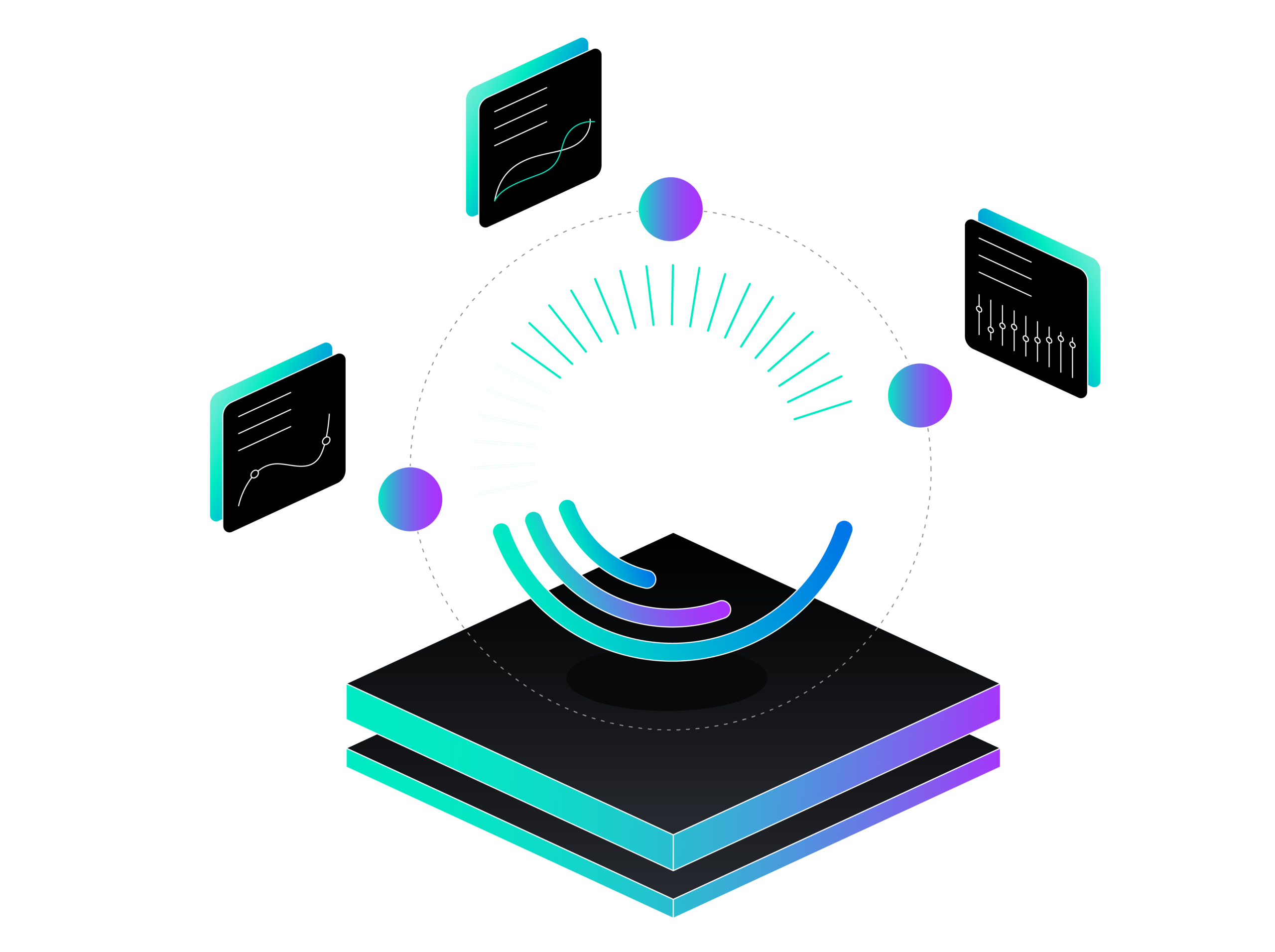
Each stage feeds the next, and outcomes from the final stage feed back into the first.
What is happening?
Multi-method anomaly detection (z-score, IQR, distributional change-point analysis), trend detection with slope significance testing, and shelf image recognition via computer vision. The system finds problems before users ask.
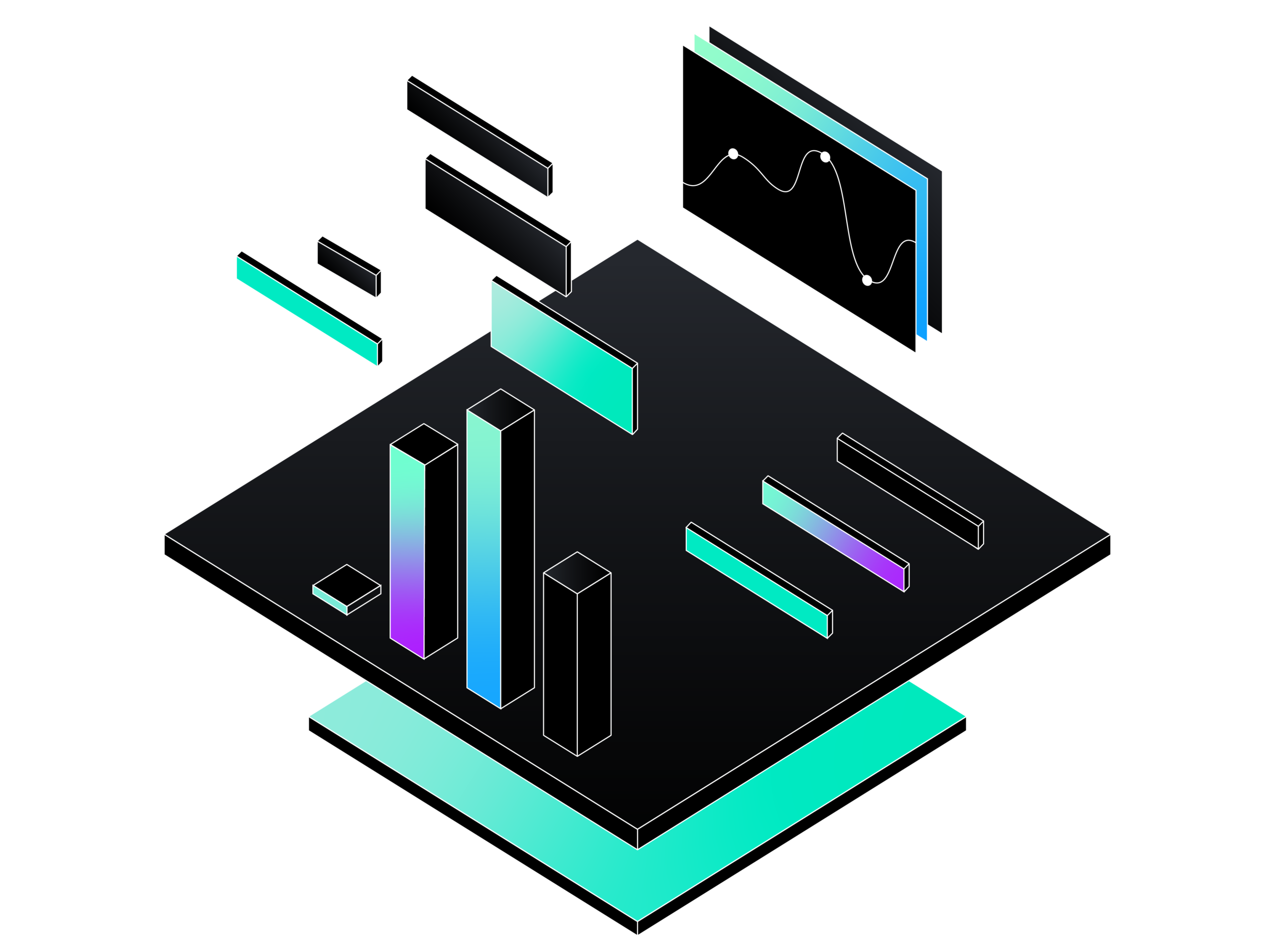
Why did it happen?
Causal driver identification using debiased ensemble inference (Double ML, Causal Forests). Shapley-value metric decomposition guaranteeing 100% attribution across volume, price, and mix. Feature importance ranking via SHAP. No unexplained residuals.

What will happen next?
14 proprietary forward-looking models covering promotion effectiveness, price impact, demand transfer, new item forecasting, on-shelf availability prediction, customer lifetime value, and scenario simulation. Each model operates within the shared knowledge graph for cross-lever reasoning.

What if we tried this?
Digital twin simulation modeling cross-lever P&L impact (price, promo, assortment, space) before execution. Monte Carlo stochastic simulation with learned effect priors and competitive response dynamics. Test any decision virtually before committing real resources.

What should we do?
Multi-objective optimization across competing goals (sales, margin, CLV) under real-world constraints (budget, competitive position, frequency limits). Cross-lever optimization that prevents conflicting recommendations across price, promo, and assortment.

How do we improve?
Bayesian online updating refines effect estimates with every action taken. Backtesting validates predictions against historical outcomes. Prediction monitoring catches model drift before it reaches users. Attribution validation ensures every causal claim passes a minimum explained variance threshold (70% or higher) before surfacing.
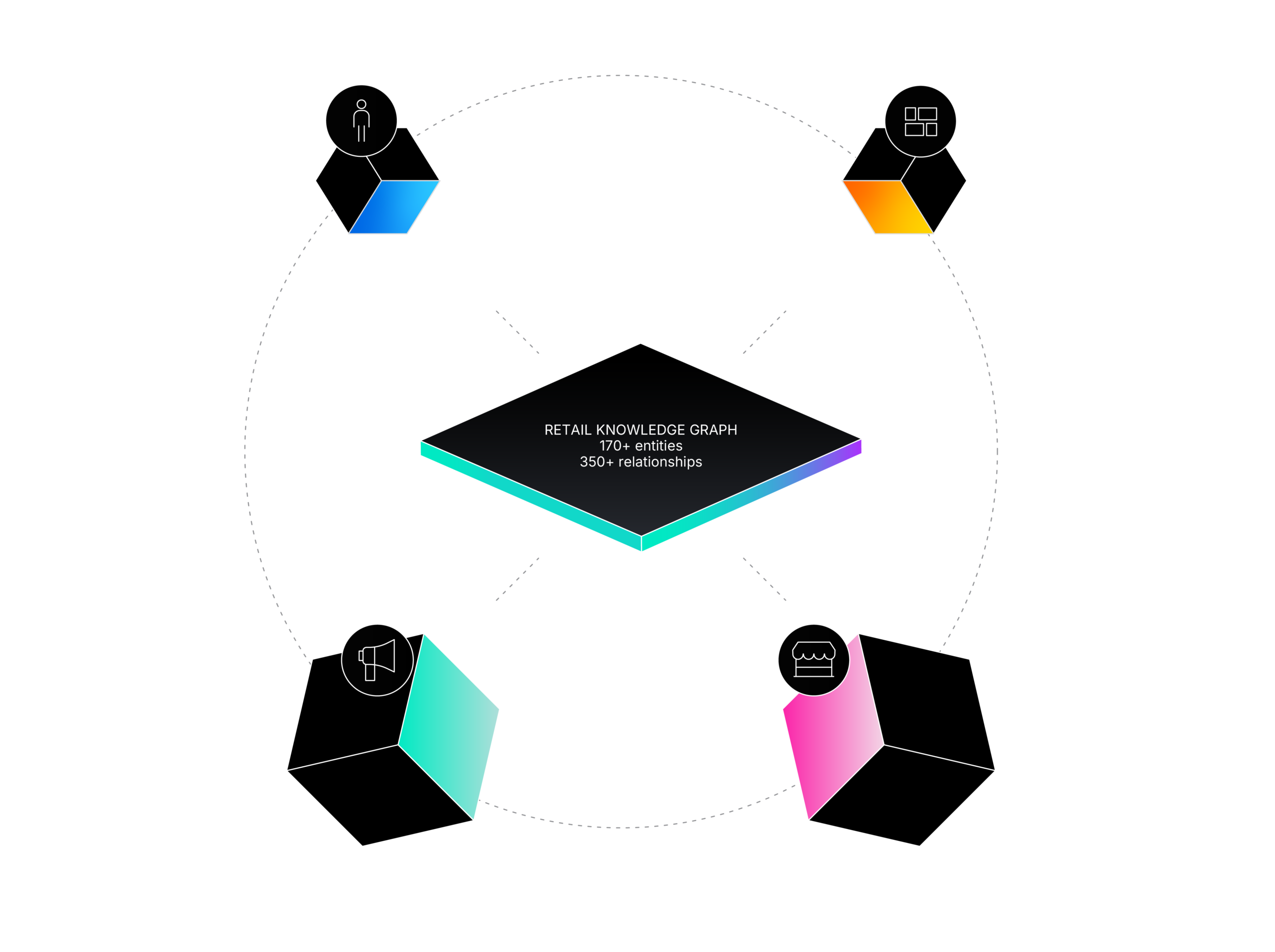
It replaces the traditional approach (ETL pipelines feeding a monolithic database) with a multi-model graph database connected to internal and external data sources through connectors and APIs.
– 170+ entity types
– 350+ relationship types
– Organized into a canonical retail ontology
A promotion effectiveness model and an assortment optimization model see the same product, the same store, the same customer segment. This eliminates the data reconciliation problem that plagues multi-vendor analytics stacks, where different tools define "category" or "store cluster" differently and produce conflicting recommendations.
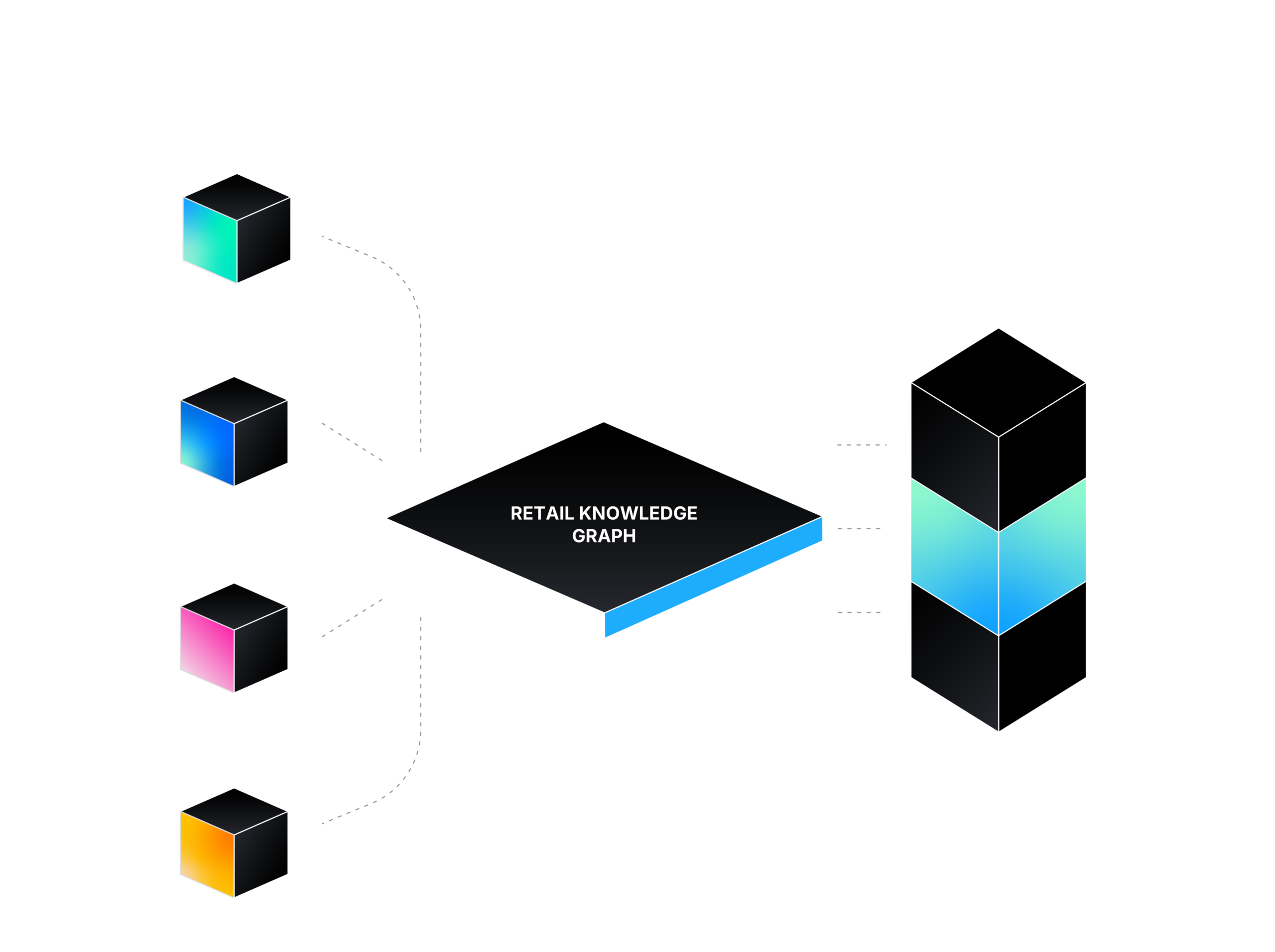
Pre-built for retail. Connected by design.

Connects:
Brand, category, pricing, supplier, lifecycle

Connects:
Segment, household, loyalty, preferences

Connects:
Geography, department, fixture, planogram

Connects:
Warehouse, shipment, carrier, quality

Entity resolution
Deduplication and linking across sources — so the same product, store, or customer is always one entity, not dozens of variants across systems.

Semantic query routing
Queries are routed to the right part of the graph automatically — no manual mapping or translation layer required between tools.

SPARQL / GraphQL API
Standard APIs so models, agents, and external tools can query the knowledge graph without custom integration work for each connection.

Explainability hub with reasoning traces and full audit trail
Every recommendation is traceable to its data source and decision logic — supporting compliance, reviews, and buyer confidence.

Time series versioning
The graph is versioned over time — models can query historical states of data, not just the current snapshot.

Data lineage tracking
Full traceability from raw source to model input — supporting audits, debugging, and regulatory accountability.
.svg)
.svg)
.svg)


CINDE retail AI includes 60+ proprietary models across six categories: detection (anomaly, trend, shelf image recognition), attribution (causal inference, metric decomposition, feature importance), prediction (demand, price impact, promotion effectiveness, customer lifetime value), simulation (digital twin, scenario modeling), optimization (multi-objective, cross-lever), and continuous learning (Bayesian updating, backtesting, drift monitoring).
A retail knowledge graph is a structured data layer that maps relationships between products, customers, stores, and supply chain entities. CINDE’s knowledge graph contains 170+ entity types and 350+ relationship types organized into four hubs (Product, Customer, Store, Supply Chain). It serves as the shared foundation for all models and agents, ensuring consistent definitions across the platform.
Copilots respond when asked a question. Agents operate continuously: they monitor data streams, detect anomalies, diagnose root causes, and recommend actions without waiting for a user prompt. CINDE’s agents perform multi-step analysis autonomously while keeping humans in control of final decisions. The merchant reviews and approves every recommendation.
Yes. CINDE’s open retail AI platform supports custom AI models alongside its proprietary model library. Your data science team can deploy custom models, build custom data connectors, and integrate third-party reatil AI agents through the platform’s extensibility layers.