Navigating The Path to NextGen AML Detection

Despite more stringent anti-money laundering (AML) regulation over the past decade, combating financial crime continues to be a major problem for financial institutions. Natwest is the latest bank to be under regulatory scrutiny but there have been a multitude of incidents during the past year as the pandemic accelerated the pace of digitalization which in turn opened the door even wider for fraud and money laundering.
In fact, regulators issued more than $10 billion in AML fines to globalfinancial institutions in 2020, a 26% hike from 2019 figures, according toresearch from Fenergo. Breaking it down, this translates into 198 fines forAML, Know your Customer (KYC), data privacy and MiFID (Markets in FinancialInstruments Directive) breaches.
The fines are not the only damaging fallout. Customer trust is broken,business is disrupted and opportunities to leverage operational efficienciesare overlooked. While overcoming these issues may seem insurmountable, the mainstumbling blocks seem to be continued reliance on outdated transactionmonitoring systems (TMS) as well as manual human processes that cannotdistinguish the noise from the real threats. As a result, criminals are able tobreak through a bank’s defenses.
Retrieving Unknown, Valuable Information
In fact, our research has shown that there is at least double theinformation content in existing data sets that is currently bypassed by TMSdetection systems. Existing systems tend to focus on short term behavior and be blind tosophisticated schemes that build over periods of a year or longer, and cruciallythey cannot “follow the money” or deal with the information content in complexbusiness ownership structures. They are simply not fit for purpose given thenature of the problem.
These are not new issues, and many financial institutions are well awareof the problems. However, there is a fear that they will have to go back to thedrawing board and invest in a complete infrastructure overhaul. This is notonly costly but also time consuming, However, as indicated in our first blog, modernizingsystems could be akin to a self-driving car. It is not a reinvention of thewheel but instead an enhancement of the technology already in place to offer amore optimal driving experience. It usesa combination of AI components that can sense, monitor, and adapt to thechanging road conditions and alert the driver when action is required.
Creating a Holistic Roadmap to Safety
It is the same with Ayasdi Sensa-NetRevealAML™. Just as with the self-driving car, there is no total redesign, but the detection technology is overlaid onto a financial institution’s prevailing framework. It uses the data already in the current TMS process and leverages AI to provide a holistic risk-based map of the dangers that lurk within a bank’s customer behavior. This helps banks better identify patterns and unpick the complex money laundering web of transactions, money flows and relationships which in the past were a blind spot.
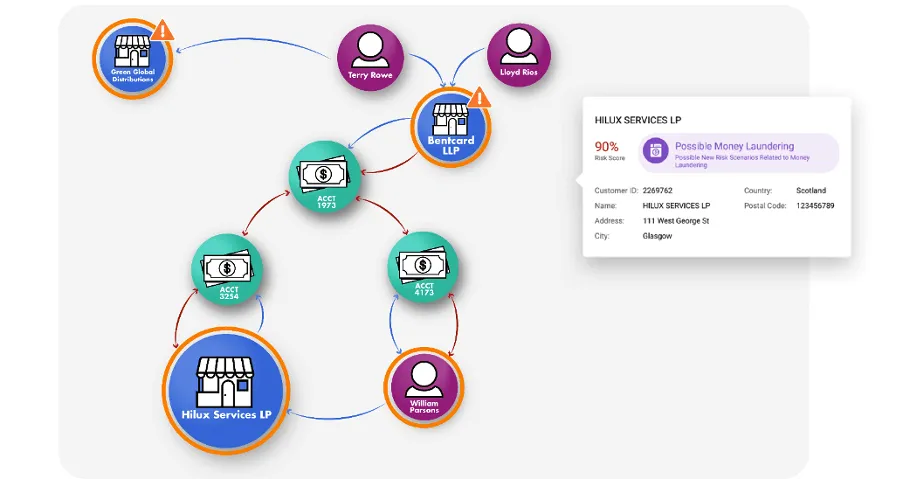
The system can detect previously hidden risks with accuracy rates of 90% and detect complex schemes a year earlier than existing processes. At a holistic level the bank can see a more accurate reading of risk with up to 60% reduction in false positives, and a roughly 20% improved total risk coverage in terms of level 3 investigations and suspicious activity reports (SARs).
As the pandemic has shown, the direction of digitalization is only one way and financial institutions that do not improve their oversight and detection rates will go off the grid. They will be overtaken by either newer or existing players who can offer a secure and safe environment to conduct business.
Despite more stringent anti-money laundering (AML) regulation over the past decade, combating financial crime continues to be a major problem for financial institutions. Natwest is the latest bank to be under regulatory scrutiny but there have been a multitude of incidents during the past year as the pandemic accelerated the pace of digitalization which in turn opened the door even wider for fraud and money laundering.
In fact, regulators issued more than $10 billion in AML fines to globalfinancial institutions in 2020, a 26% hike from 2019 figures, according toresearch from Fenergo. Breaking it down, this translates into 198 fines forAML, Know your Customer (KYC), data privacy and MiFID (Markets in FinancialInstruments Directive) breaches.
The fines are not the only damaging fallout. Customer trust is broken,business is disrupted and opportunities to leverage operational efficienciesare overlooked. While overcoming these issues may seem insurmountable, the mainstumbling blocks seem to be continued reliance on outdated transactionmonitoring systems (TMS) as well as manual human processes that cannotdistinguish the noise from the real threats. As a result, criminals are able tobreak through a bank’s defenses.
Retrieving Unknown, Valuable Information
In fact, our research has shown that there is at least double theinformation content in existing data sets that is currently bypassed by TMSdetection systems. Existing systems tend to focus on short term behavior and be blind tosophisticated schemes that build over periods of a year or longer, and cruciallythey cannot “follow the money” or deal with the information content in complexbusiness ownership structures. They are simply not fit for purpose given thenature of the problem.
These are not new issues, and many financial institutions are well awareof the problems. However, there is a fear that they will have to go back to thedrawing board and invest in a complete infrastructure overhaul. This is notonly costly but also time consuming, However, as indicated in our first blog, modernizingsystems could be akin to a self-driving car. It is not a reinvention of thewheel but instead an enhancement of the technology already in place to offer amore optimal driving experience. It usesa combination of AI components that can sense, monitor, and adapt to thechanging road conditions and alert the driver when action is required.
Creating a Holistic Roadmap to Safety
It is the same with Ayasdi Sensa-NetRevealAML™. Just as with the self-driving car, there is no total redesign, but the detection technology is overlaid onto a financial institution’s prevailing framework. It uses the data already in the current TMS process and leverages AI to provide a holistic risk-based map of the dangers that lurk within a bank’s customer behavior. This helps banks better identify patterns and unpick the complex money laundering web of transactions, money flows and relationships which in the past were a blind spot.
The system can detect previously hidden risks with accuracy rates of 90% and detect complex schemes a year earlier than existing processes. At a holistic level the bank can see a more accurate reading of risk with up to 60% reduction in false positives, and a roughly 20% improved total risk coverage in terms of level 3 investigations and suspicious activity reports (SARs).
As the pandemic has shown, the direction of digitalization is only one way and financial institutions that do not improve their oversight and detection rates will go off the grid. They will be overtaken by either newer or existing players who can offer a secure and safe environment to conduct business.