When the same platform wins recognition for a vertical product and for its orchestration layer independently, that tells you something about the engineering decisions underneath.
SymphonyAI was recognized in three categories of the 2026 Business Intelligence Group Artificial Intelligence Excellence Awards: Orchestration for our Eureka AI Platform, Manufacturing for our IRIS Foundry product platform, and Fraud Detection and Prevention for our Sensa Risk Intelligence product platform. I’m excited and wanted to take a moment to explain why these three recognitions are actually inseparable — and what that means for enterprises evaluating AI platforms.
1. The problem we engineered Eureka to solve
When enterprise teams attempt to build production AI on horizontal platforms, the same three failure modes appear repeatedly. We see this across every industry we operate in.
The first is brittle glue code integration. Horizontal platforms provide model access, but no structured orchestration surface. Teams end up assembling workflows from prompt chains and API calls — no versioning, no testing framework, no rollback mechanism. Every upstream change introduces a silent failure risk.
The second is flat retrieval. RAG retrieves semantically similar text, and that is useful for document search. But enterprise AI workflows require traversing relationships. A compliance agent needs to answer: “Who are the beneficial owners of this entity, and do any appear on a secondary sanctions list?” A manufacturing agent needs to understand: “What failure mode does this vibration pattern predict, given this asset’s maintenance history and connected systems?” RAG operates in vector space. It does not understand ownership chains, transaction typologies, or governed entity relationships.
The third is agent sprawl. Without a governance layer, agents proliferate across an enterprise — different teams, different data, no shared permission model, no central view of what decisions are being made or what downstream systems are being affected. This is not just an operational problem. Governance has to be architectural. You cannot bolt it on after the fact.
All three failures trace to the same root cause: a missing middle layer between the foundation model and the enterprise. The hyperscalers have built strong infrastructure — model access, compute, developer tools. But they do not build that middle layer. They leave it entirely to the customer.
2. How the Eureka enterprise AI orchestration platform is structured
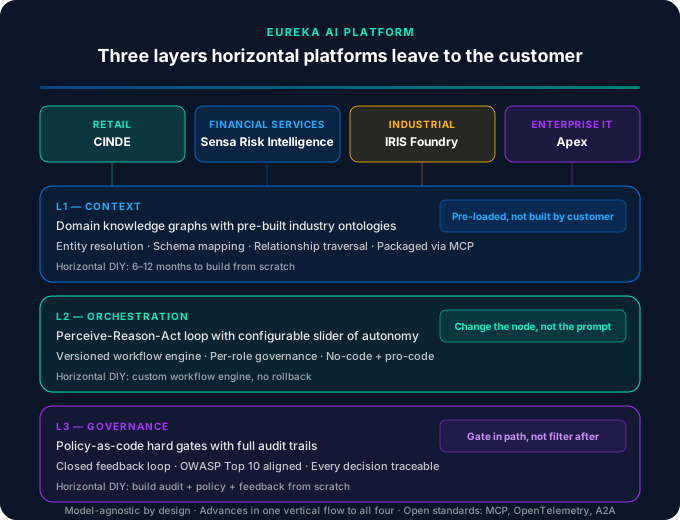
Eureka provides three layers that address these failures architecturally, not through configuration or professional services.
Layer 1: Context. Domain Knowledge Graphs with pre-built industry ontologies — entity resolution, schema mapping, relationship traversal. Packaged so any model can consume governed enterprise context through a standard interface. This is not a retrieval layer. It is a governed, traversable knowledge graph. In financial services, the graph understands beneficial ownership chains. In retail, it models how a promotion in one category affects adjacent categories. In industrial, it maps sensor data to asset hierarchies, failure modes, and shift schedules. That context is pre-loaded — not built by the customer over 6–12 months.
Layer 2: Orchestration. Eureka Flow runs a Perceive-Reason-Act loop with a slider of autonomy. A single workflow can include fully autonomous steps alongside steps that require human approval — configurable per workflow, per role, per customer. The governance policy determines which steps are which. Because the workflow logic lives in a versioned, structured engine rather than in system prompts, when a step changes, you change the node, not the prompt. This distinction matters significantly in regulated environments.
Layer 3: Governance. Policy-as-code acts as a hard gate before any output reaches a user or triggers a downstream action. Not a filter applied after deployment — a gate in the execution path. Every agent decision that gets overridden or flagged flows back into the policy engine through a closed feedback loop.
One deliberate architectural choice deserves separate mention: Eureka is model-agnostic by design. This is not a hedge — it is a compounding advantage. The context layer, the orchestration layer, and the governance layer grow more valuable with every production deployment, regardless of which model runs underneath them. Model capability is the fastest-commoditizing layer in this stack. We made the engineering investment one layer up — in governed context, orchestration, and policy enforcement. Those compound with every production deployment. When a better model ships from Anthropic, OpenAI, Google, or an open-source fine-tune, we swap it in without rearchitecting anything.
3. Why this produces cross-vertical leverage
Eureka powers four product lines simultaneously: CINDE for retail, Sensa Risk Intelligence for financial services, IRIS Foundry for industrial manufacturing, and APEX for enterprise IT. This is not a branding exercise. It is an architectural consequence.
When we build a governance capability for regulated financial services — where every agent decision must produce an audit trail that a compliance officer would sign off on — that capability is available for industrial deployments where safety-critical decisions require the same rigor. When we optimize a knowledge graph traversal pattern in retail, that optimization improves how we structure manufacturing data. The platform compounds across verticals because it is genuinely shared, not duplicated.
This is the architectural leverage that a horizontal toolkit cannot generate, regardless of how broad its feature set.
Horizontal platforms ship toolkits. Eureka ships governed context, orchestration, and governance as native infrastructure.
4. Production evidence
The test of any architecture is production outcomes. SymphonyAI serves over 2,000 enterprise customers across 40+ countries.
Every one of those metrics traces to a specific architectural decision in Eureka. Data onboarding is fast because domain connectors and knowledge graphs are pre-built. Model deployment is fast because the domain ontology is pre-loaded. Investigation time drops because the platform surfaces structured evidence automatically rather than requiring manual assembly.
5. What this means for platform evaluation
The 2026 AI Excellence Awards recognized Eureka, IRIS Foundry, and Sensa Risk Intelligence in separate categories. That separation is itself informative: it validates that a vertical product and its underlying enterprise AI orchestration platform can each stand on their own merits, while being stronger together.
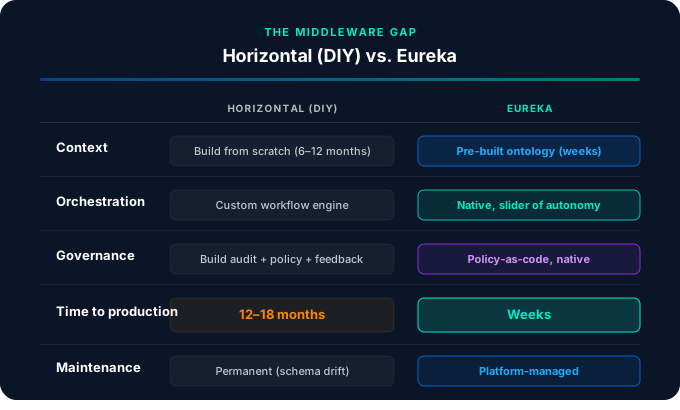
For enterprises evaluating AI platforms, I would suggest a specific question: how long does it take to go from contract signature to a governed production workflow — with a full audit trail that your compliance or safety team would sign off on? The answer to that question is the clearest signal in this market. Everything else is feature comparison. Time to governed production is what separates platform from a sales deck.
Learn more about the Eureka AI Platform architecture or see production outcomes across retail, financial services, industrial, and enterprise IT.