Turn compliance overload into your strongest fraud defense with agentic AI

Key takeaways
- Layered AI strategy transforms compliance: Financial institutions are moving from manual, reactive compliance processes to proactive and resilient operations by integrating predictive, generative, and agentic AI.
- Three AI types work in tandem: Predictive AI flags anomalies from historical data, reducing false alerts; generative AI synthesizes vast data sources to speed up investigations and risk management; agentic AI autonomously completes complex tasks, turning investigators into strategic decision-makers.
- Dramatic efficiency gains: AI implementation leads to major improvements, such as up to 80% reduction in false positives, up to 3× faster customer onboarding, and the ability to process millions of records and produce audit-ready reports in minutes.
- Strategic and competitive advantages: Blending all AI layers enables banks to anticipate threats, respond quickly to regulatory changes, and turn compliance burdens into business advantages.
- Real-world impact demonstrated: Case studies show how AI enables rapid correlation of complex data, transparent risk scoring, and quick production of regulator-ready documents, which previously required weeks of manual work.
The rise of AI agents like SymphonyAgents provide an all-encompassing approach to financial crime mitigation
For years, financial institutions have faced a familiar but escalating dilemma with regulatory demands multiplying faster than headcount and budgets. As such, manual investigations pile up, legacy alert engines stumble, and fraudsters exploit every gap. It’s a recipe for burnout and risk.
Today, a layered AI strategy is emerging, which transforms compliance from a reactive cost center into a proactive, resilient operation. In a conversation between The Banker and Jason Shane, Head of Strategy and Product Innovation for SymphonyAI’s financial services division, one question kept coming up: How do you turn compliance into your firm’s sharpest fraud-fighting edge?
The answer lies in Symphony Risk Intelligence and successfully orchestrating three AI stages: Predictive → Generative → Agentic.
Types of AI used in financial crime prevention
Predictive, generative, and agentic AI work together across financial crime investigation and prevention processes to dramatically improve compliance.
1. Predictive AI: Smarter alerts, fewer misses
How it works: Models learn from historical transactions and behavior to flag anomalies.
Leadership insight: Predictive layers replace brittle, rules-only systems—cutting noise but still leaving manual triage.
2. Generative AI: Investigate at speed
How it works: Analyzes and synthesizes complex data from disparate sources, enabling faster detection of financial crime and smarter risk management.
Leadership insight: Teams can investigate alerts much more quickly using the likes of a Copilot, allowing for enhanced productivity.
3. Agentic AI: Autonomous investigation and action
How it works: Intelligent agents execute end-to-end workflows - summarizing investigations, conducting web research, and creating SAR files.
Leadership insight: Seamlessly complete complex processes. Investigators shift from data wranglers to strategic decision-makers.
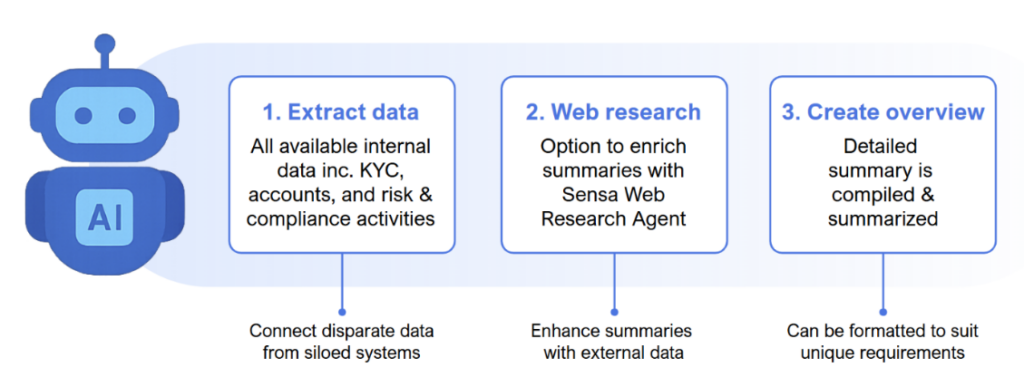
Agentic AI in action - an example of the Symphony Summary Agent
The human value of using agentic AI
Despite the many benefits of agentic AI , it can sometimes be hard for leaders to visualize. Here’s an example case study that shows the vast capabilities of AI in all its forms.
Marcus is Group Head of Compliance at a European bank with €350b in assets. He is navigating a high-stakes merger, which brings together multiple data points. Under the old model, his team spent weeks manually weaving together sanctions lists, wire-transfer logs, and customer files, only to scramble when new risks emerged.
With AI in place, Marcus can:
- Correlate millions of records in minutes
- Prioritize genuine customer risks using transparent, explainable scoring
- Produce detailed investigation summaries and regulator-grade suspicious activity reports on demand
What once took weeks now happens in minutes. With explainability built in, audit trails at the click of a button, and regulators getting answers before they ask them, AI provides a revolutionary approach to financial crime compliance.
Learn more about Symphony Agents
Beyond efficiency and building strategic resilience
By blending predictive, generative, and agentic AI, compliance transforms into a forward-looking risk engine, anticipating threats, acting with confidence, and turning regulatory burden into competitive advantage.
Banks and other financial institutions that implement AI have seen amazing results including:
- ~80% noise reduction: Advanced models cut false positives, so teams focus on real threats. See our recent case studies .
- 3× faster onboarding: Automated AI-led alerts compress days of manual effort into hours or even minutes.
- Global agility: Pre-configured AI modules adapt in real time to new global regulations and sanctions lists.
Ready to see AI in action?
Connect with our financial services experts today to explore how SymphonyAI can transform your compliance operations.
Whether you are looking into Symphony Risk Intelligence, our award-winning AI-led case management system , AI overlays for sanctions or AML, or Symphony Agents , our committed sales team will find the right solutions for your needs.
Get in touch to learn more.
Related resources
AI-led compliance in financial services
The 50/50 Compliance Model
The power of agentic AI for AML operations
Why regulators love agentic AI
FinCrime Frontier 2025/26 - Report
White paper - AI in Action
Learn more about Symphony Risk Intelligence
The AI-native FinCrime platform designed to help financial institutions move from reactive to proactive risk management.
The main types are predictive, generative, and agentic AI, each addressing different aspects of compliance and investigation. Working together using software like Symphony Risk Intelligence, they improve alerts, accelerate investigations, and automate complex tasks for financial institutions.
Agentic AI autonomously manages end-to-end workflows such as investigation summaries and SAR file creation. This shifts investigators from manual data handling to focusing on strategic decision-making and risk management.
Banks can experience up to 80% reduction in false positives, saving valuable time for compliance teams. Investigation processes that used to take weeks can now be completed in minutes, and customer onboarding is up to three times faster.
AI-led compliance solutions feature pre-configured modules that adapt in real time to changing global regulations and sanctions lists. This ensures institutions remain compliant and agile without significant manual intervention.
AI enables institutions to anticipate threats and proactively address risks, turning compliance from a reactive cost center into a forward-looking strategic asset. This approach streamlines operations and supports business growth amid changing regulatory environments.