2024 U.S. anti-money laundering (AML) Regulatory Roundup

2024 has been a pivotal year for U.S. anti-money laundering (AML) regulations.
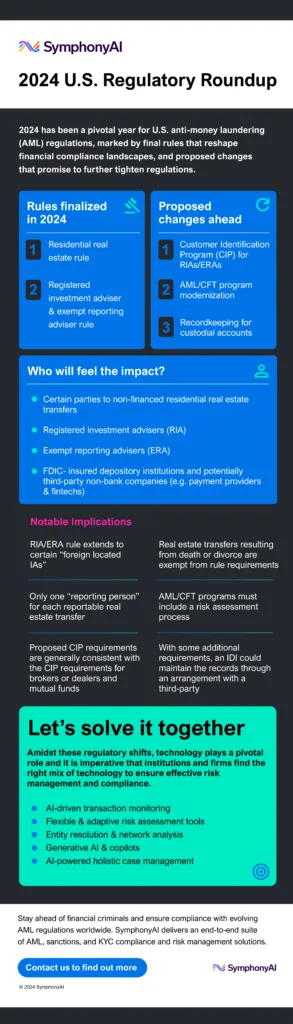
This year was marked by final rules that reshape financial compliance landscapes, and proposed changes that promise to further tighten regulations.
Rules finalized in 2024
- Residential real estate rule
- Registered investment adviser and exempt reporting adviser rule
Proposed changes ahead
- Customer Identification Program (CIP) for RIAs/ERAs
- AML/CFT program modernization
- Recordkeeping for custodial accounts
Who will feel the impact?
- Certain parties to non-financed residential real estate transfers
- Registered investment advisers (RIA)
- Exempt reporting advisers (ERA)
- FDIC- insured depository institutions and potentially third-party non-bank companies (e.g. payment providers & fintechs)
Notable Implications
- RIA/ERA rule extends to certain “foreign located IAs”
- Only one “reporting person” for each reportable real estate transfer
- Proposed CIP requirements are generally consistent with the CIP requirements for brokers or dealers and mutual funds
- Real estate transfers resulting from death or divorce are exempt from rule requirements
- AML/CFT programs must include a risk assessment process
- With some additional requirements, an IDI could maintain the records through an arrangement with a third-party
Let’s solve it together
Amidst these regulatory shifts, technology plays a pivotal role and it is imperative that institutions and firms find the right mix of technology to ensure effective risk management and compliance.
- AI-driven transaction monitoring
- Flexible & adaptive risk assessment tools
- Entity resolution & network analysis
- Generative AI & copilots
- AI-powered holistic case management
Stay ahead of financial criminals and ensure compliance with evolving AML regulations worldwide. SymphonyAI delivers an end-to-end suite of AML, sanctions, and KYC compliance and risk management solutions.
Contact us
Discover the value of SymphonyAI

Elizabeth Callan is a recognized leader and innovator in the fightagainst money laundering and financial crime with 25 years of experience acrossintelligence, law enforcement, and the private sector. At SymphonyAI, she is atthe forefront of redefining the future of financial crime compliance and riskmanagement. She drives strategy and innovation, developing groundbreakingAI-led, intelligence-driven solutions that are transforming how globalinstitutions detect, disrupt, and prevent money laundering, sanctions evasion,and other sophisticated financial crimes. Her work is helping to shift theindustry approach from reactive, technical compliance to proactive, risk -aligned, and highly effective risk management. Prior to SymphonyAI, Elizabethserved in the U.S. intelligence and law enforcement communities. As a SeniorIntelligence Analyst at the Central Intelligence Agency and the U.S. Departmentof the Treasury, she shaped high-impact U.S. policy and enforcement actions —including Section 311 designations — while directly advising senior officialsacross the USG, including at OFAC and FinCEN, on critical threats and nationalsecurity strategies. She also served as Intelligence Liaison and Senior Advisorto the DEA’s Special Operations Division, where she led complex, large-scalemoney laundering investigations, enhanced intelligence collection efforts,trained law enforcement agents and analysts, and forged strong internationalpartnerships. In the private sector, Elizabeth has held leadership roles in financialinstitutions and consulting firms, where she built and managed investigationsteams, designed robust AML and sanctions programs, and developed riskmanagement strategies for complex products and services. A recognized subjectmatter expert, Elizabeth teaches AML and sanctions courses at the universitylevel. She holds a master's degree in economics and analytics and ACAMS’Advanced Certification in Financial Crimes Investigations (CAMS-FCI).