New changes to Canada's AML / TF law

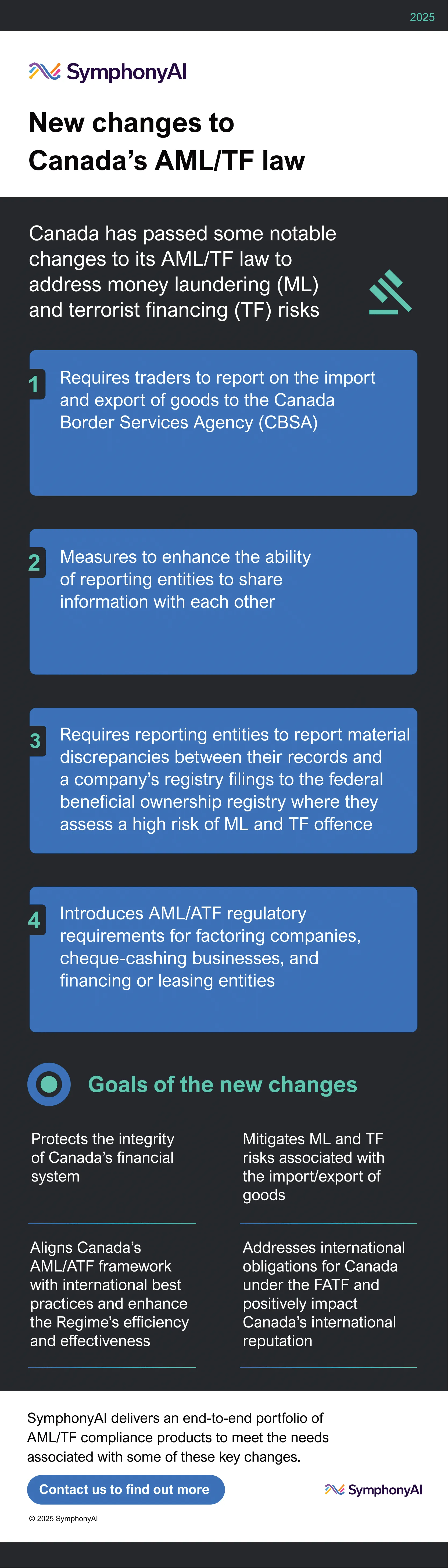
Canada has passed some notable changes to its AML/TF law to address money laundering (ML) and terrorist financing (TF) risks
- Requires traders to report on the import and export of goods to the Canada Border Services Agency (CBSA).
- Measures to enhance the ability of reporting entities to share information with each other.
- Requires reporting entities to report material discrepancies between their records and a company’s registry filings to the federal beneficial ownership registry where they assess a high risk of ML and TF offence.
- Introduces AML/ATF regulatory requirements for factoring companies, cheque-cashing businesses, and financing or leasing entities.
Goals of the new changes
- Protects the integrity of Canada’s financial system
- Mitigates money laundering and terrorist financing risks associated with the import and export of goods
- Aligns Canada’s AML/ATF framework with international best practices and enhance the Regime’s efficiency and effectiveness
- Addresses international obligations for Canada under the FATF and positively impact Canada’s international reputation
SymphonyAI delivers an end-to-end portfolio of AML/TF compliance products to meet the needs associated with some of these key changes.
Contact us to find out more.
Discover the value of SymphonyAI
Canada combats terrorist financing through a comprehensive legal and regulatory framework that includes measures to detect, prevent, and disrupt financial support for terrorist activities. Key components include strict AML/CTF laws, regulations requiring financial institutions to conduct customer due diligence, and the obligation to report suspicious transactions. Canada also collaborates internationally with organizations like the FATF and the United Nations to coordinate efforts against terrorist financing.
Terrorist financing in AML refers to the process of providing funds or financial support to individuals, groups, or activities that are intended to facilitate terrorist acts. In the context of AML, financial institutions and other entities implement measures to detect and prevent such activities, ensuring compliance with regulations designed to combat the financing of terrorism.
Terrorist financing in AML refers to the process of providing funds or financial support to individuals, groups, or activities that are intended to facilitate terrorist acts. In the context of AML, financial institutions and other entities implement measures to detect and prevent such activities, ensuring compliance with regulations designed to combat the financing of terrorism.
Yes, Canada is a member of the Financial Action Task Force (FATF), an intergovernmental organization that sets international standards for combating money laundering and terrorist financing. As a FATF member, Canada is committed to implementing and adhering to the FATF's recommendations and standards.
FINTRAC is the acronym for the Financial Transactions and Reports Analysis Centre of Canada, the country's financial intelligence unit. It is responsible for collecting, analyzing, and disclosing financial information to law enforcement and partner agencies to assist in the detection and deterrence of money laundering, terrorist financing, and other financial crimes.