Your plant intelligence is locked in a PDF. Let's change that.
P&IDs describe how every asset, valve, instrument, and connector in your plant relates to everything else — making them the most critical, and most underused, data asset in any refinery, chemicals plant, power facility, or food and beverage operation. Most still exist as scanned drawings no AI can read. IRIS Foundry ingests, extracts, verifies, and maps them into a structured asset model wired directly into the unified namespace and knowledge graph — so every downstream AI initiative runs on real plant topology from day one. For teams building toward a digital twin, predictive maintenance, or agentic AI workflows, this is where that journey starts.
P&ID digitization is not a document project. It's the foundation for every AI initiative that follows.
Digital twin, predictive maintenance, agentic AI, connected-worker copilots — every initiative stalls when it can't answer the most basic question: "How is this plant wired together?" P&ID digitization gives your AI a deterministic, structured model of your operations to reason against. Without it, every team rebuilds that context by hand, for every project. Done once in IRIS Foundry — it feeds everything.
From static drawing to structured plant intelligence
IRIS Foundry’s P&ID ingestion transforms engineering drawings into machine-readable plant models. Vision AI trained specifically on P&IDs — not a general-purpose model — identifies every asset, tag, valve, instrument, and connector. Text is classified against tag formats and bound to the graphical element it labels. The result isn’t a digitized image; it’s a structured layer of plant intelligence.
Every digitized P&ID is verified element-by-element before it enters your asset hierarchy — because P&IDs drive safety-critical decisions and accuracy matters more than speed. Asset hierarchy mapping is 70–80% automated by AI, with the remainder flagged for engineer review. Programs that take 9–12 months manually complete in weeks.
Ingest, extract, verify, map — a clear path from drawing to data
How IRIS Foundry takes a PDF and produces production-grade plant intelligence in four steps.


Ingest
Upload a single P&ID or a bulk drawing set covering a plant, line, area, or entire facility network. Multi-page diagrams ingested as a group. Duplicate flags prevent double-counting before extraction begins.


Extract
Vision AI trained on P&ID symbol libraries identifies every element — assets, tags, valves, instruments, connectors — and assigns a confidence score to each. The drawing moves from analyzing to unverified.


Verify
Engineers review the extraction element by element. A quality gate, not a bottleneck — because P&IDs drive safety-critical decisions. Each verified drawing becomes training data for your custom model.


Map
Automap with AI: 70–80% of entities resolve automatically against your existing asset hierarchy. Lower-confidence matches surface for engineer review. Custom models retrain on your verified drawings, improving accuracy with every iteration.
300+ agents. Every critical operation covered.
Pre-built agents are production-ready across the highest-impact use cases in industrial operations

Alarm management and RCA
Intelligent alarm responders triage alerts in real time—filtering noise, identifying root causes, and routing actions to the right operator or system before issues escalate.

Predictive maintenance
Maintenance coordinator agents connect asset health scores from Predictive Asset Intelligence to work order systems—automatically scheduling interventions based on failure probability and operational priority.

Shift intelligence
Shift handover agents capture and contextualize operational events, KPI deviations, and open actions—so every shift starts with a complete, accurate picture of plant status.

Process optimization
Optimization planner agents continuously analyze process conditions, model alternative setpoints, and recommend or execute adjustments to maximize yield, throughput, or energy efficiency.

Safety and compliance
Agents monitor safety-critical conditions, trigger permit-to-work workflows, and coordinate inspection and compliance actions across connected worker systems—maintaining audit trails automatically.

Custom agent creation
Build domain-specific agents using a visual designer or natural language. Agents inherit the Industrial LLM’s contextual understanding of your assets, processes, and data—no training data preparation required.
Asset mapping automated by AI. IRIS Foundry resolves the majority of P&ID entities against your existing hierarchy. Engineers review the flagged remainder.
Typical program duration. Programs that take 9–12 months to complete manually are substantially done in weeks with IRIS Foundry's AI-assisted workflow.
What becomes possible when your P&IDs are alive
P&ID digitization isn't an end in itself. It's what makes every downstream initiative across IRIS Foundry faster, more accurate, and more reliable.
Explore IRIS Foundry
Predictive models don't just know a sensor's value — they know what equipment it's attached to, what process it feeds, and what failure modes are in scope. P&ID-derived asset context turns an alert into an explanation.

Automated HAZOP workflows require a complete, up-to-date process topology to trace consequences through a system. P&ID digitization supplies that topology. Without it, every HAZOP review falls back to manual line tracing — slow, error-prone, and hard to audit.

MOC reviews require validating current P&ID accuracy. When drawings are stale, compliance teams slow approvals or absorb risk they can't see. Digitized, current P&IDs make every change review traceable and faster.

Digital twin simulations run on topology. Topology comes from P&IDs. IRIS Foundry's P&ID digitization supplies the deterministic plant model that makes digital twin outputs reliable — not approximations built from incomplete data.

Senior engineers who carry the plant in their heads are retiring. P&ID digitization surfaces accumulated context — personal markups, undocumented exceptions, and workarounds absorbed over decades — and structures it before it leaves.
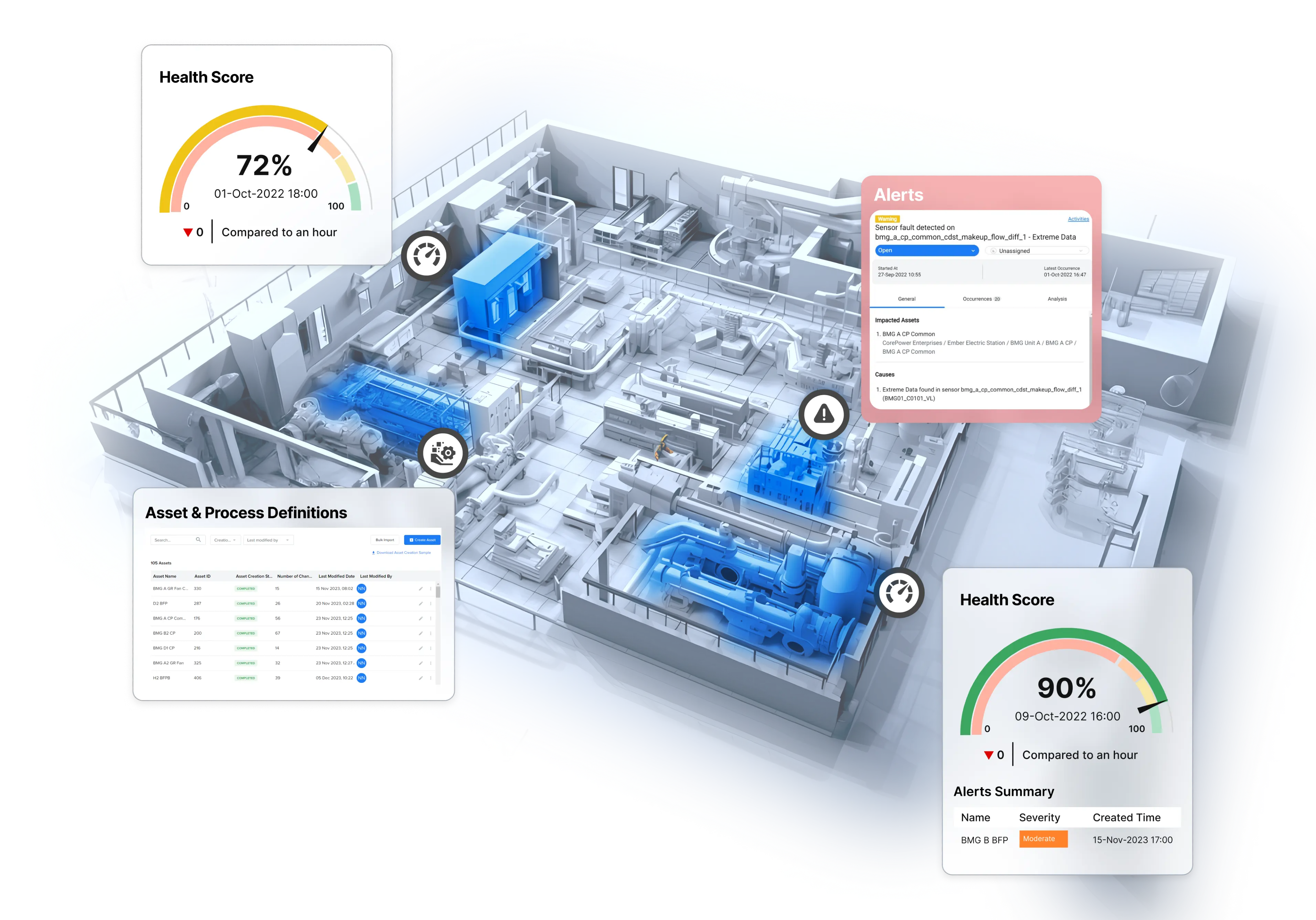
P&ID digitization is the foundation. Asset performance intelligence is what you build on it.
The asset topology you verify during P&ID digitization becomes the context layer for every predictive model that follows — failure mode detection, anomaly scoring, and work order prioritization all run better when they know what equipment they’re watching and how it connects. IRIS Foundry’s Asset Performance Intelligence builds directly on your digitized plant model.
Explore Asset Performance IntelligenceOne capability, wired into the full IRIS Foundry platform
P&ID digitization in IRIS Foundry is not a standalone tool. Every verified drawing feeds the shared foundation that powers prediction, agents, and operational AI across the platform.

Digitized P&IDs give every tag a topological home — not just a numeric value. Assets, instruments, and their relationships flow directly into the unified namespace, making each tag more meaningful to every downstream system that reads it.

P&ID-derived asset hierarchies, failure modes, and process relationships become nodes and edges in the Cortex (knowledge graph) — making root cause analysis, fault tracing, and KPI diagnostics navigable through structured intelligence.



Questions about P&ID digitization in IRIS Foundry
Straight answers for engineering leads and OT teams evaluating P&ID digitization as part of a broader industrial AI program.

OCR reads text. P&ID digitization reads the diagram. It uses Vision AI models trained on P&ID symbol libraries to identify equipment, instruments, and pipelines — then classifies extracted text against tag formats and reconstructs the topology between elements, not just the labels on them. The output isn’t a tagged image; it’s a structured asset model.
Element-level extraction confidence is reported on every entity. In IRIS Foundry, digitized P&IDs achieve 100% accuracy through element-by-element human verification before any data enters the asset hierarchy. Asset hierarchy mapping is typically 70–80% automated by AI, with the remainder flagged for engineer review.
Yes. IRIS Foundry can map P&ID entities into an existing hierarchy or build one from scratch by exporting extracted entities and creating assets directly from the diagrams. This is especially useful for greenfield digital transformation programs where no CMMS or EAM baseline exists yet.
No — imperfect drawings are expected, not a blocker. IRIS Foundry’s element-by-element verification step is specifically designed as a quality gate: engineers review each extracted entity, flag discrepancies, and confirm or correct before data enters the asset hierarchy. Stale or inconsistent drawings surface gaps and prompt resolution, rather than silently polluting downstream data.
Digitized P&IDs become part of the unified namespace and IRIS Cortex knowledge graph that power IRIS Foundry. Predictive models, digital twin simulations, and agentic workflows draw on the topology P&ID digitization supplies — making downstream AI both more accurate and more explainable.
Yes. IRIS Foundry supports custom model retraining: verified P&IDs become training data to build models tuned to a specific industry’s drawing conventions. A different model can be selected at ingestion time depending on the drawing type — so a food and beverage plant and an O&G refinery use different extraction logic.
Yes. Every verified element — assets, tags, valves, instruments, and topology — is accessible via IRIS Foundry’s API and data connectors. The platform supports integration with PI, SEEQ, SCADA historians, and downstream analytics tools.
Go deeper on P&ID digitization
Latest thinking, demos, and technical depth for teams planning a P&ID digitization program.
One platform: IRIS Foundry, Forge, and Flows
One unified data foundation, one way to build new AI applications, and one layer of agentic execution, built to work together across your plant.

The industrial DataOps platform that unifies DCS, LIMS, historians, MES, and ERP data into one governed, AI-ready foundation.


Your P&IDs hold the plant model your AI needs. Put it to work.
Whether you're starting with a pilot on one process unit or planning a plant-wide rollout, IRIS Foundry's P&ID ingestion is built to scale with your program. Talk to an expert who knows your industry — not a generalist.
