


Financial Services
.svg)

Returning from the latest Transform Finance event in Amsterdam, it is clear that the conversation around AI in financial crime has shifted decisively. What was once theoretical is now becoming tangible. The industry is no longer asking if AI can transform financial crime prevention, but how to deploy it responsibly, effectively, and at scale.
At the summit, I had the opportunity to speak on “Integrated Intelligence: Applying Agentic AI to Financial Crime Control,” followed by a roundtable discussion exploring the opportunities and risks of self-learning AI models in compliance. What stood out most across both sessions was not just interest, but engagement. There is a growing urgency among financial institutions to move beyond experimentation and begin operationalizing these capabilities.
One conversation I had with a senior leader further highlighted the need to leverage Agentic AI to reduce the impact of data fragmentation across domains such as AML, sanctions, and fraud, while in some cases strengthening the enrichment of customer connections required for onboarding and broader financial crime activities.
They were not alone and this shift marks an important inflection point.
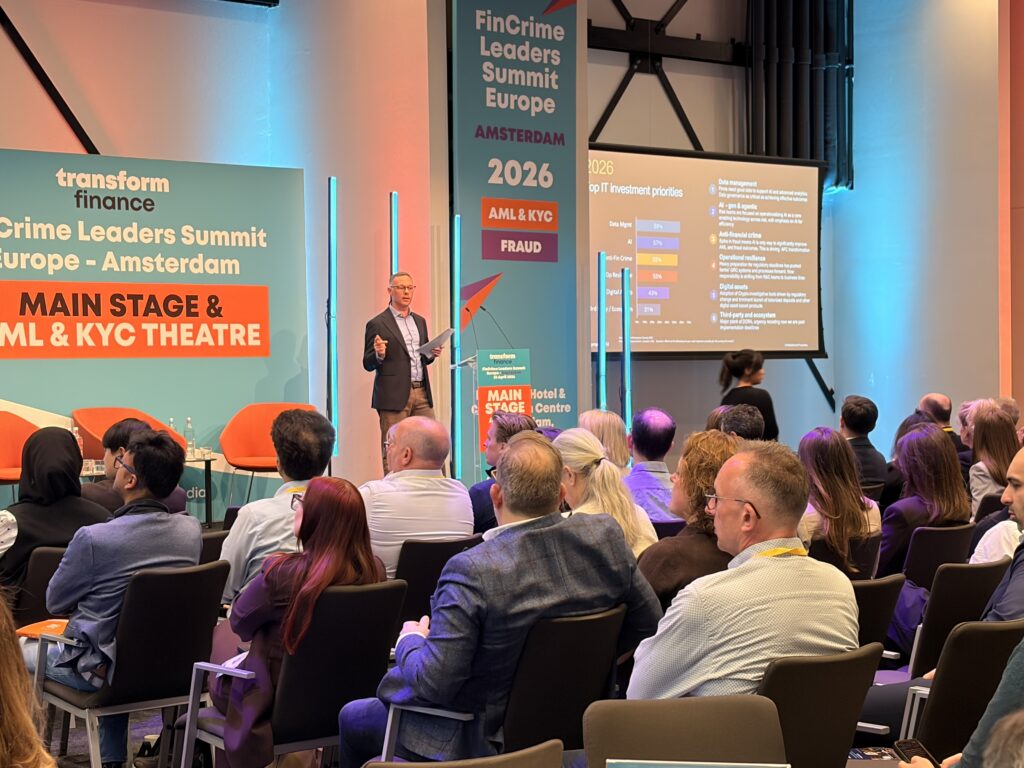
Marco Beranzoni delivering his speech at the 4th Annual FinCrime Leaders Summit in Amsterdam
One of the most consistent themes across discussions with industry professionals was, in fact, the need to break down silos. For decades, financial crime controls have been structured in distinct domains such as anti-money laundering (AML), fraud detection, and sanctions screening, each with its own systems, data, and processes.
While this approach has delivered incremental improvements, it has also created fragmentation. Signals are missed. Context is lost. Investigations become inefficient. Most importantly, decision-making is constrained by incomplete information.
Agentic AI introduces a fundamentally different approach.
Rather than operating as isolated models solving narrow tasks, agentic systems can coordinate across domains, ingesting diverse data sources and dynamically orchestrating actions. This enables a more holistic view of financial crime risk, one that reflects the interconnected nature of modern threats.
In practice, this could mean linking transaction monitoring with fraud signals in real time, enriching alerts with contextual intelligence, and enabling systems to adapt based on evolving patterns. The goal is not just automation, but integration, what we might call integrated or embedded intelligence.
To this end, I highly recommend that you watch our recent webinar on this topic - Re-engineering the Risk-Based Approach and the accompanying whitepaper.
Another key insight from the summit was the evolving expectation of what AI should deliver. Historically, much of the focus has been on efficiency, reducing false positives, accelerating investigations, and lowering operational costs.
While these remain important, the conversation is expanding toward decision quality.
Financial crime prevention is, at its core, a decision-making discipline. Analysts must interpret signals, assess risk, and determine appropriate actions, often under time pressure and regulatory scrutiny. Traditional rule-based systems provide limited support in this context, and even earlier generations of machine learning models have struggled to offer transparency or adaptability.
Again, agentic AI has the potential to change this dynamic.
By combining reasoning capabilities with contextual awareness, agentic systems can assist not just in identifying anomalies, but in evaluating them. They can prioritize cases, suggest investigative pathways, and even simulate potential outcomes based on different decisions. This shifts AI from being a tool for automation to a partner in decision-making.
However, with this increased capability comes increased responsibility.
Perhaps the most critical, and complex, theme discussed at the summit was governance.
As AI systems become more autonomous and adaptive, maintaining control becomes more challenging. Questions around responsible AI - explainability, auditability, and accountability - move to the forefront. Regulators are rightly focused on ensuring that decisions can be understood, justified, and reviewed.
Agentic AI amplifies these concerns.
Unlike static models, agentic systems can evolve over time, learning from new data and interactions. While this enables continuous improvement, it also introduces variability. Without proper oversight, there is a risk of unintended behaviors, bias amplification, or loss of transparency.
To address this, organizations must rethink their governance frameworks.
This includes implementing strong monitoring mechanisms, establishing clear boundaries for system behavior, and ensuring that human oversight remains integral to critical decisions. Explainability must be built into the system design, not treated as an afterthought. Audit trails should capture not just outcomes, but the reasoning processes that led to them.
Transparency also plays a critical role in enabling adoption. Senior management must be able to clearly understand how these systems operate and how outcomes are generated in order to be comfortable with their use. Regardless of the level of automation, accountability ultimately remains with human decision-makers, and governance frameworks must reflect that responsibility by ensuring sufficient visibility into system behaviour and outputs.
In other words, trust must be engineered into the system.
Beyond technology and governance, agentic AI also prompts a broader question of how financial crime operations should be structured in the future.
Many current processes are built around the limitations of legacy systems. Investigations are often linear, manual, and reactive. Analysts spend significant time gathering data, switching between tools, and performing repetitive tasks.
Agentic AI creates an opportunity to redesign these workflows from the ground up.
Imagine an environment where alerts are not simply generated, but contextualized. Where investigations are dynamically guided by intelligent systems. Where decisions are supported by real-time insights and historical knowledge. And where continuous learning enables the system to improve with each interaction.
This is not about replacing human expertise. It is about augmenting it. In practice, this still requires keeping a human firmly in the loop. Across real-world applications, human judgement remains a core component of the process - providing oversight, validating outcomes, and ensuring that decisions are contextually sound and defensible.
Analysts can focus on higher-value tasks, such as complex case analysis and strategic decision-making, while AI handles data aggregation, pattern recognition, and routine processes. The result is a more efficient, effective, and resilient operating model. At SymphonyAI, we are putting this idea into practice through Symphony Risk Intelligence and the idea of Always-on Compliance, which I encourage you to investigate further.
The energy at the FinCrime Leaders Summit reflected an industry in transition. There is widespread recognition of the potential of agentic AI, but also a clear understanding that realizing this potential requires careful execution.
Moving from concept to operational reality involves several key steps:
Importantly, success will not come from technology alone. It will require collaboration across compliance, risk, technology, and business teams. There will need to be engagement with regulators. Also, there needs to be a willingness to challenge existing assumptions about how financial crime prevention should operate.
This reflects a point raised in a recent discussion with a senior leader: “The challenge is no longer understanding the potential of AI - it’s embedding it into day-to-day operations in a controlled and scalable way.”
Agentic AI is no longer a distant vision. It is emerging today as a practical tool with the potential to reshape financial crime control. The focus now is on applying it responsibly, balancing innovation with governance, and efficiency with decision quality.
The conversations in Amsterdam made one thing clear, which is that the industry is ready to engage with this challenge.
As we look toward the second half of 2026 and beyond, the organizations that succeed will be those that embrace embedded intelligence, invest in strong governance, and reimagine their operating models. They will move beyond siloed thinking and toward a more connected, adaptive approach to financial crime prevention.
From Theory to Action: AI Agents Transforming Financial Crime Compliance in Real-Time
Whitepaper: The New Financial Crime Ecosystem
Reinventing the compliance operating model
Agentic AI, Data, and Financial Crime Control
Case study: 90% reduction in manual effort: The power of AI agents in sanctions compliance
Find out more about Symphony Risk Intelligence and Always-on Compliance, and how it can improve your approach to transaction monitoring, KYC/CDD, fraud, and screening.
Unlike earlier ML models that solve narrow, isolated tasks, agentic AI coordinates across domains, linking AML, fraud, and sanctions data in real time to build a more complete picture of financial crime risk.
Siloed systems cause signals to be missed and context to be lost. When AML, fraud, and sanctions operate independently, investigators make decisions on incomplete information, which is a gap that agentic AI is designed to close.
No. The goal is augmentation, not replacement. Human judgement remains central for oversight, validating outcomes, and ensuring decisions are defensible. AI handles data aggregation, pattern recognition, and routine processes so analysts can focus on complex, higher-value work.
Governance must be built in from the start — not bolted on. This means monitoring system behaviour, setting clear boundaries, maintaining audit trails that capture reasoning (not just outcomes), and ensuring senior management has sufficient visibility to remain accountable for decisions.
Yes. The industry has moved past the "if" question and is now focused on the "how" - defining clear use cases, ensuring data readiness, and building governance frameworks that meet regulatory expectations.

Marco is a financial crime prevention specialist with nearly two decades of experience across AML, sanctions, and financial intelligence. He currently works as a Financial Crime Technology Consultant and advisor at SymphonyAI, supporting financial institutions in the design and implementation of technology-led financial crime compliance solutions. Alongside his industry role, Marco is the founder of FinCrime Agent, an independent initiative focused on practical, role-based insights into financial crime prevention, aimed at helping professionals bridge the gap between theory and real-world application. Marco regularly speaks at industry events and contributes to discussions on the evolving intersection of regulation, technology, and operational financial crime risk. He has also participated as a speaker at OECD-led forums, engaging with policymakers, regulators, and private-sector stakeholders on topics including trade-based money laundering, sanctions, and emerging typologies. His work is grounded in practical application, with a strong focus on how financial crime frameworks operate in real institutions and how professionals can make sound, defensible risk-based decisions in complex environments.