Agentic AI, Data and Financial Crime Control

A new generation of AI systems is emerging – systems that can observe, reason, act, and escalate in real time. These autonomous systems, often described as agentic AI, represent a significant shift from traditional automation. Instead of simply detecting patterns, AI is increasingly able to investigate risk signals, form hypotheses, and support decision-making within financial crime workflows.
For institutions facing rising regulatory expectations and increasingly sophisticated criminal activity, this evolution will reshape how financial crime prevention operates.
The limits of traditional automation
Over the past decade, institutions have invested heavily in automation and analytics. Despite this progress, many compliance teams still face persistent challenges: high volumes of alerts, fragmented investigations, and manual processes that slow down decision-making.
Traditional systems were built for a different era of financial crime. They typically rely on predefined rules, batch processing, and sequential workflows that pass information between separate systems. Transaction monitoring, sanctions screening, and customer due diligence often operate as distinct processes rather than connected intelligence functions.
This architecture creates operational bottlenecks. Analysts must move between systems to gather information, reconstruct customer relationships, and determine whether suspicious activity is genuine. Even straightforward cases can require hours of manual analysis, while more complex investigations may take days.
As criminal networks adopt more sophisticated tactics using layered transactions, cross-border networks, and rapidly changing identities, these traditional systems are reaching the limits of what they can detect and investigate effectively.
Closing the data convergence gap
Most institutions already possess a wealth of information relevant to financial crime risk. Transaction histories reveal behavioral patterns, customer records provide identity context, and network data can expose relationships between entities.
The challenge is not the absence of data, but the lack of integration and linked intelligence.
The four domains of transactional, behavioral, network, and threat data are key to developing risk intelligence. Transactional, behavioral signals, and external intelligence sources are often stored in separate environments. As a result, manual assembling of data is often done that could otherwise be analyzed together to surface risk, intelligence, and insights faster.
Agentic AI introduces the concept of a convergence intelligence layer, a unified analytical environment where multiple data signals can be interpreted simultaneously. When transactional activity, customer risk indicators, network relationships, and external intelligence are combined, AI systems can uncover patterns that would be difficult for human investigators or traditional models to detect.
In this environment, AI does not simply identify anomalies. It interprets relationships between data points and risk signals, and determines whether those signals collectively indicate genuine financial crime risk.
Evolving to unlock agentic AI capabilities
The role of AI in financial crime detection is evolving. The mix of analytical AI, gen AI, and agentic AI is proving key to driving sustainable outcomes and Always-on Compliance.
Machine learning models focus on prediction. They help identify suspicious patterns within large datasets and assign risk scores to transactions or customers.
Generative AI now assists investigators by compiling case summaries, structuring information, and drafting narratives. This reduces administrative work and allows analysts to focus more on investigative judgment.
Meanwhile, agentic AI introduces reasoning; AI agents capable of performing tasks autonomously and making decisions. These systems analyze multiple datasets simultaneously, form hypotheses about suspicious activity, gather additional information to validate or dismiss those hypotheses, and take action to finish or recommend a conclusion.
Rather than acting as passive analytical tools, these agents function more like collaborators within financial crime teams.
How agentic AI investigates risk
To understand how an agentic AI system differs from traditional monitoring in practice, consider a scenario where suspicious transaction activity triggers an alert. In a traditional system, this alert is where the process stops and human effort begins. An investigator must manually gather contextual information, review transaction histories, identify counterparties, analyze ownership structures, and search for related activity across accounts.
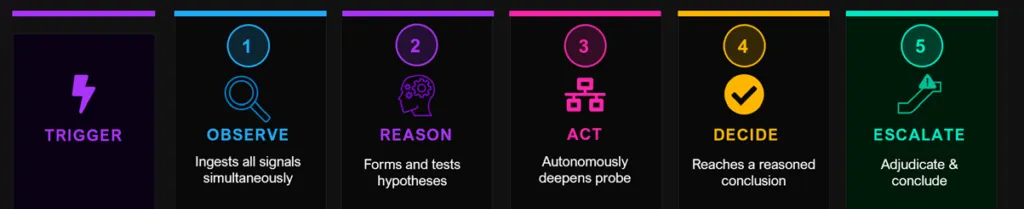
With agentic AI, much of this investigative groundwork can occur automatically.
AI agents ingest relevant internal and contextual data simultaneously, including customer profiles, historical transaction behavior, network relationships, and external intelligence sources. The system evaluates possible explanations for the activity – for example, structuring behavior, sanctions evasion patterns, or legitimate business transactions.
The agent can then pursue these hypotheses by retrieving additional data, exploring network connections between entities, and examining related transactions across accounts. Once sufficient evidence is gathered, the system produces investigation artifacts and a natural-language summary of its findings, along with a recommendation on whether the case requires escalation.
The outcome is faster investigations and a transparent record of every decision, giving compliance teams the speed they need without sacrificing the explainability and auditability regulators demand.
Trust, governance, and human oversight
As institutions adopt more advanced AI capabilities, governance cannot be understated. Regulatory frameworks globally are placing greater emphasis on transparency, explainability, and responsible AI deployment. Agentic AI systems must therefore be designed with compliance in mind from the outset.
Human oversight remains a central element.
For example, investigators validate findings, make final decisions on complex cases, and ensure outcomes align with institutional policies and regulatory expectations. AI systems support these decisions by organizing evidence, identifying patterns, and accelerating investigative workflows.
Equally important is explainability. Every AI-driven conclusion must be traceable, with a clear reasoning path that compliance teams and regulators can understand. Transparent models, auditable decision logic, and clear documentation of investigative steps are essential components of trustworthy AI systems.
When these governance principles are embedded into system design, AI enhances compliance functions rather than complicates them.
From insight to action
One of the persistent challenges in financial crime prevention has been the gap between identifying suspicious signals and acting on them effectively.
Financial institutions have long possessed the analytical tools to detect anomalies within data. What has been more difficult is translating those insights into coordinated action across complex operational environments.
Agentic AI helps bridge this gap by combining analysis, investigation, and decision support within a single intelligent workflow. Instead of merely generating alerts, AI systems can investigate those alerts, assemble relevant evidence, and present investigators with structured conclusions.
This approach allows financial crime teams to focus more on judgment and strategy, while AI handles the repetitive and time-intensive aspects of investigation.
The future of financial crime intelligence
Financial crime networks are becoming increasingly sophisticated, leveraging global connectivity, rapid digital transactions, and complex organizational structures to evade detection. To respond effectively, institutions need systems capable of operating at comparable speed and scale. Agentic AI provides a path toward that capability by combining converged data intelligence, autonomous investigation, and strong governance frameworks. This enables a more proactive model of financial crime prevention – moving beyond reactive alert handling toward continuous, intelligent risk assessment. While adoption will take time, the direction is clear: the future of financial crime prevention will rely on systems that can reason, investigate, and support decisions at the speed and scale required by today’s financial ecosystem.
Related resources
Re-engineering the Risk-based approach with agentic AI - webinar
Re-engineering the risk-based approach with agentic AI - white paper
Whitepaper: The New Financial Crime Ecosystem
Reinventing the compliance operating model
From Reactive to Proactive: Managing Regulatory Compliance with AI
Command and Control Rewired: Agentic AI in Anti-Financial Crime
Learn more about Symphony Risk Intelligence
Contact us to find out more about Symphony Risk Intelligence and Always-on Compliance and to receive a personalized demo.

Charmian Simmons is a Financial Crime and Compliance Expert covering Financial Services at SymphonyAI. She has over 20 years of experience in the financial sector across risk management, financial crime, internal controls and IT advisory. She is a technology evangelist specialising in AI innovations and transformation. Charmian is responsible for providing practitioner expertise, thought leadership and analysing key policy, regulatory and technology drivers transforming the compliance market. Prior to joining Symphony AI, Charmian was a Fincrime Expert with BAE Systems, a Regional Director of Strategy and Performance for the Risk business at Refinitiv, the Head of Audit in North America at Lloyds Banking Group USA and a Vice President at Morgan Stanley covering Institutional Securities and Capital Markets. Charmian is CAMS, CDPSE, CRMA and CISA certified.