Digital Twins: Represent industrial environments with an integrated, real-time operational model

Break down silos and bring clarity to complex industrial environments with digital twins designed for human understanding. By unifying diverse data—from time series and P&ID diagrams to 3D models, images, and beyond—you create a connected, contextual view of operations. Simplify the creation, deployment, and scaling of digital twins across assets and locations to accelerate transformation and boost efficiency.
Challenges faced by manufacturers
- Data remains siloed and inaccessible: Accessibility of industrial data poses a significant hurdle. Often confined within disparate systems, accessing the right data is laborious for data scientists and application builders when building, deploying, and scaling industrial solutions.
- Volume of data is rapidly increasing: With an exponential increase in data generation, managing industrial data at scale is becoming increasingly difficult. Current estimates suggest data generation will increase by 50% over the next 2 years.
- Industrial data lacks context: Current strategies to consolidate industrial data into a data lake or lakehouse result in data swamps unusable by onsite personnel or data science teams. Without context, finding and verifying trusted data becomes a near-impossible task.
- Digital initiatives are moving too slowly: Many digital initiatives remain stuck, unable to scale beyond pilots or one-time use case deployments. Challenges include inconsistent naming conventions, vendor lock-in, and heterogeneous asset protocols.
- Industrial AI is missing production scale: Predictive AI models can’t be deployed at scale without tedious manual data work. AI/ML platforms often lack industrial domain expertise.
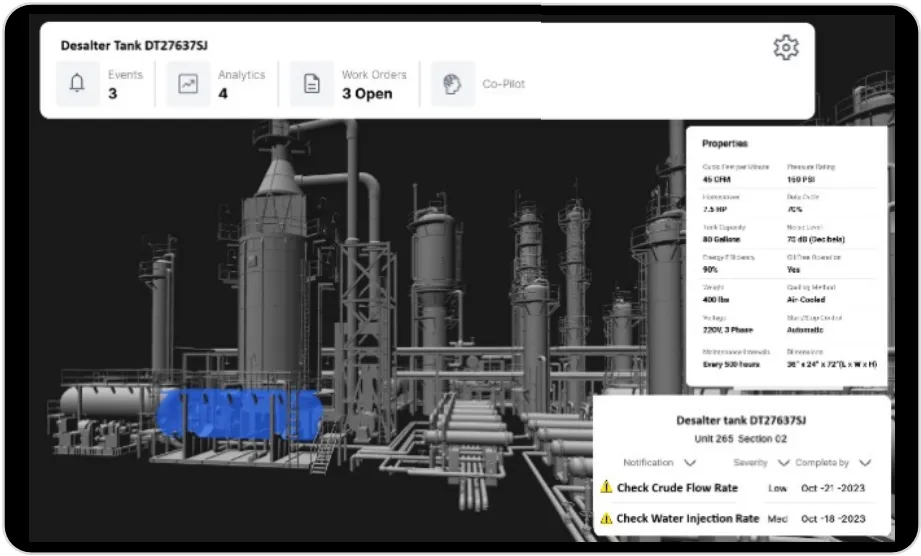
- Disconnected from operational context: 3D models are often outdated and not aligned with real-time sensor data or asset conditions.
SymphonyAI Industrial DataOps
A digital twin should be seen not as a single all-encompassing model, but a modular ecosystem of micro twins, each built for a specific function (e.g., condition monitoring, optimization, maintenance). These twins evolve independently, scale as needed, and avoid rigid centralized systems.
IRIS Foundry enables this with:
- Productized AI (Generative + Predictive)
- Industrial LLMs
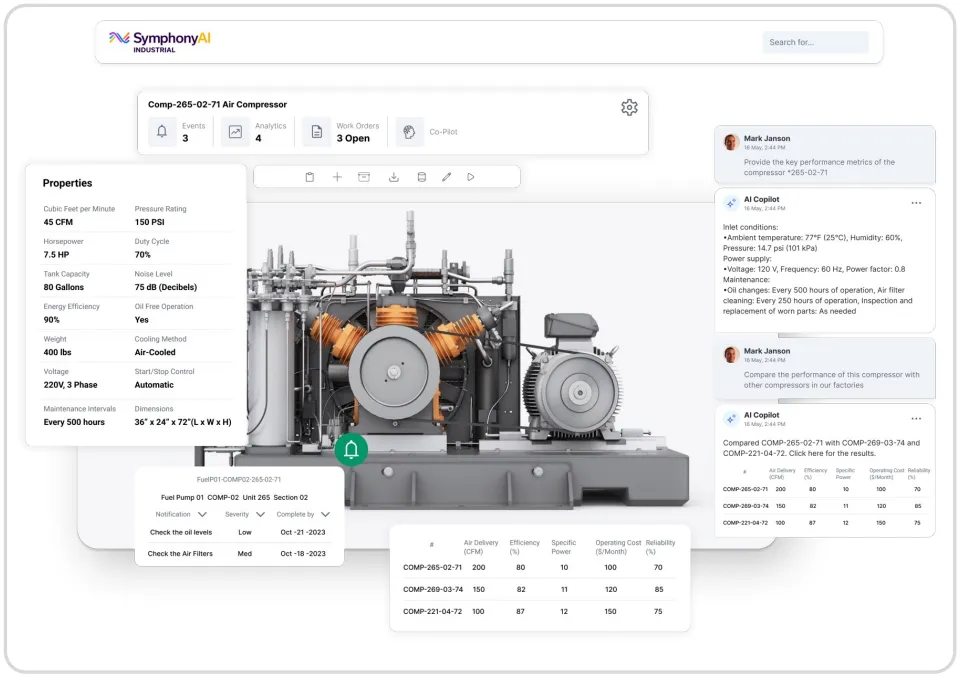
- Role-based copilots
- Prebuilt domain models
- Low-code UX
- Flexible deployment: SaaS or private cloud
Managing contextualized data at scale
Industrial DataOps powers high-quality data orchestration across dynamic systems.
IRIS Foundry offers:
- Prebuilt connectors from IT, OT, and engineering sources
- Polyglot data stores
- Structured asset hierarchies via AI-powered P&ID ingestion
- Unified namespace & industrial knowledge graph
- Support for audit, governance, and security standards
- Up to 60% faster decision-making with unified operational data visualization.
What is an industrial digital twin?
A digital twin is a real-time, dynamic representation of a physical asset, system, or process. It unifies and contextualizes data—sensor readings, logs, models, specs—into an interactive, searchable environment.
Benefits include:
- Break down silos: Prebuilt connectors to SAP, MQTT, OPC, Azure, and more.
- Contextualize & visualize: Unified namespace, AI-powered P&ID, 3D visualization.
- Scale AI insights: MLOps Studio, synthetic data, role-based copilots in IRIS Foundry.
- Up to 80% faster incident response using real-time contextualized 3D/2D data.
Key capabilities
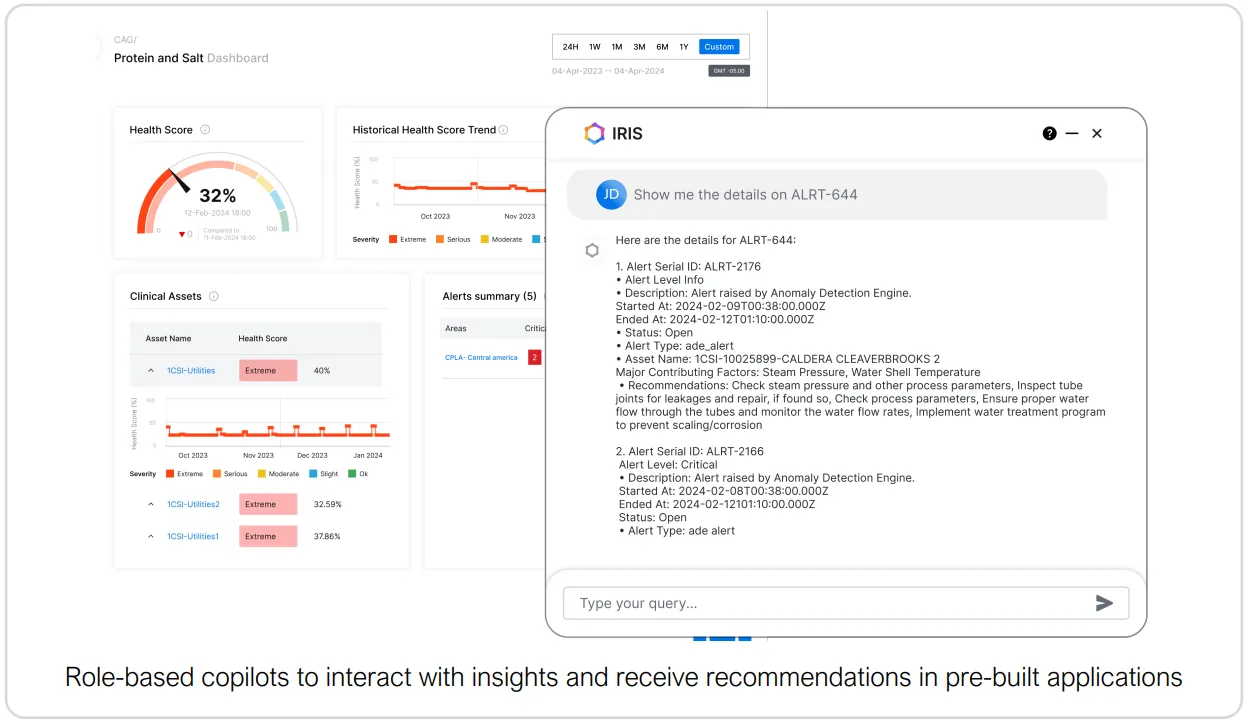
- Role-based copilots: Interact with predictive insights via prebuilt applications.
- Industrial workflow apps: Tailored apps for asset performance and connected workers.
- Live sensor overlays: Real-time 3D views of plant data.
- Real-time fault visualization: Highlight issues in 3D.
- Unified namespace: API-accessible single digital view.
- Industrial knowledge graph: Simplifies navigation and analysis.
- Multi-perspective views: Tailored digital twins for Ops, Maintenance, Engineering.
- Industrial Copilot (Generative AI): Natural language queries for insights.
- Linked 3D navigation: Clickable access to P&IDs, documents, and time series.
- 2D/3D diagram integration: Seamless navigation across visual formats.