Driving Operational Harmony: What Industrial Leaders Are Actually Demanding from AI

At Hannover Messe 2026, the world’s largest industrial trade show, the message from the floor couldn’t have been clearer: the era of passive dashboards and isolated point solutions is over. Executives from some of the world’s most complex industrial operations — global steel producers, multinational food and beverage conglomerates, heavy equipment manufacturers, energy technology leaders, and major packaging companies spanning every continent — weren’t there to be impressed by demos. They were there to solve real problems, at scale, now.
Here’s what they told us.
The Mandate Has Shifted: From Visualization to Execution
The most consistent theme across every conversation was a collective fatigue with software that shows you the problem but doesn’t help you fix it. Operations leaders are done with legacy platforms that surface data without driving decisions. The directive from the C-suite is unambiguous: AI must move from insight to action.
What’s driving this urgency? Three converging pressures: volatile supply chains that punish reactive operations, energy costs that erode margins before teams can respond, and a wave of workforce retirements taking decades of institutional knowledge out the door. Leaders aren’t looking for another tool to manage. They’re looking for a platform that can act.
What’s Actually Working: Vertical Agentic AI Built for Industry
The organizations gaining the most ground aren’t deploying generic AI. They’re deploying Vertical Agentic AI — systems purpose-built for the industrial ecosystem, trained on industry-specific data, and capable of executing decisions rather than just recommending them.
The capabilities that are delivering real results:
- An Industrial LLM trained on 7 trillion industry-specific data points — giving AI the contextual fluency to interpret operational signals the way an experienced engineer would.
- Unified OT and IT data — consolidating legacy and modern assets into a single, actionable intelligence layer rather than leaving teams to reconcile disconnected systems.
- Pre-built industrial templates with human-in-the-loop agents — enabling shop floor operators and executive teams alike to act on AI recommendations in plain language, without requiring data science expertise.
- Non-disruptive deployment — every existing OT and IT system remains intact and is further empowered rather than replaced.
The organizations seeing the fastest results are treating AI not as a replacement for their people or their infrastructure, but as a force multiplier for both.
The Biggest Obstacles: Vendor Sprawl and Data Silos
If there was a single pain point that came up in every conversation, it was this: too many systems, not enough integration. Complex industrial environments — whether a diversified industrial group running parallel materials and engineering businesses, a global dairy producer managing dozens of production sites, or a multinational mining operation coordinating assets across hemispheres — are all grappling with the same structural problem. Years of point solutions have created architectures that are almost impossible to get meaningful intelligence out of.
The specific constraints operations leaders are prioritizing:
- Slow OT data ingestion that delays decision-making and renders real-time AI impractical.
- Legacy network bottlenecks that prevent data from reaching the systems that need it.
- Vendor sprawl that multiplies integration complexity and creates compounding technical debt.
- Fragmented digital transformation programs that have delivered dashboards but not outcomes.
Rising energy costs are accelerating the pressure to resolve these issues. The margin impact of inefficient architecture is no longer theoretical — it shows up in quarterly results.
The Two Questions Every Enterprise Leader Is Asking
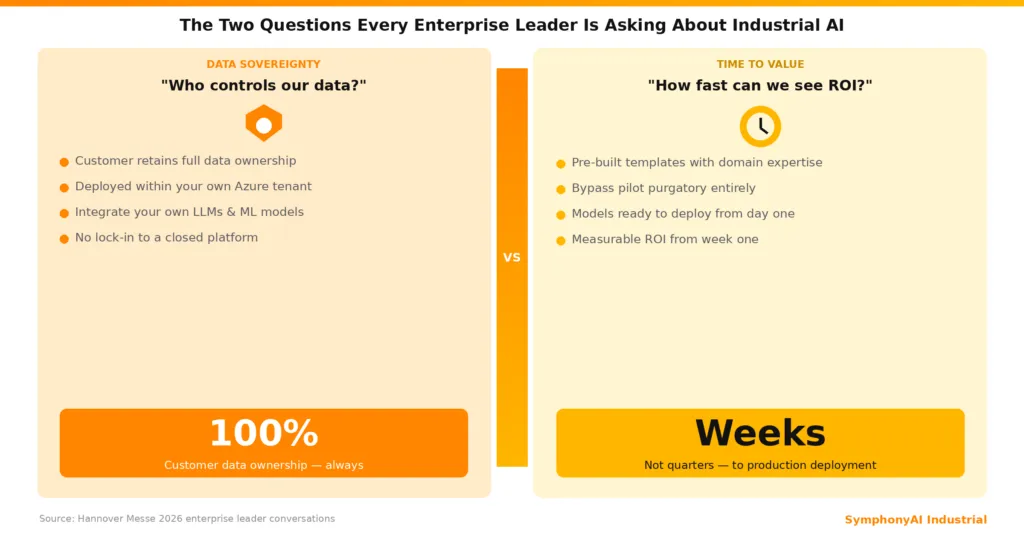
When conversations turned to implementation, two concerns came up with near-universal consistency, regardless of industry, geography, or company size: “How fast can we see ROI?” and “Who controls our data?”
- On data sovereignty: Organizations want — and increasingly require — full ownership of their data within their own infrastructure. The model that’s resonating is one where the customer retains complete control within their own Microsoft Azure tenant, with the flexibility to integrate their own LLMs and ML models into the ecosystem rather than being locked into a closed platform.
- On time to value: The phrase “pilot purgatory” came up repeatedly. Leaders have lived through too many AI projects that proved the concept but never reached production. The expectation now is deployment in weeks, not quarters — driven by pre-built templates infused with deep domain expertise that bypass the slow, from-scratch model-building that has historically killed enterprise AI momentum.
What Leaders Expect AI to Deliver — In Year One
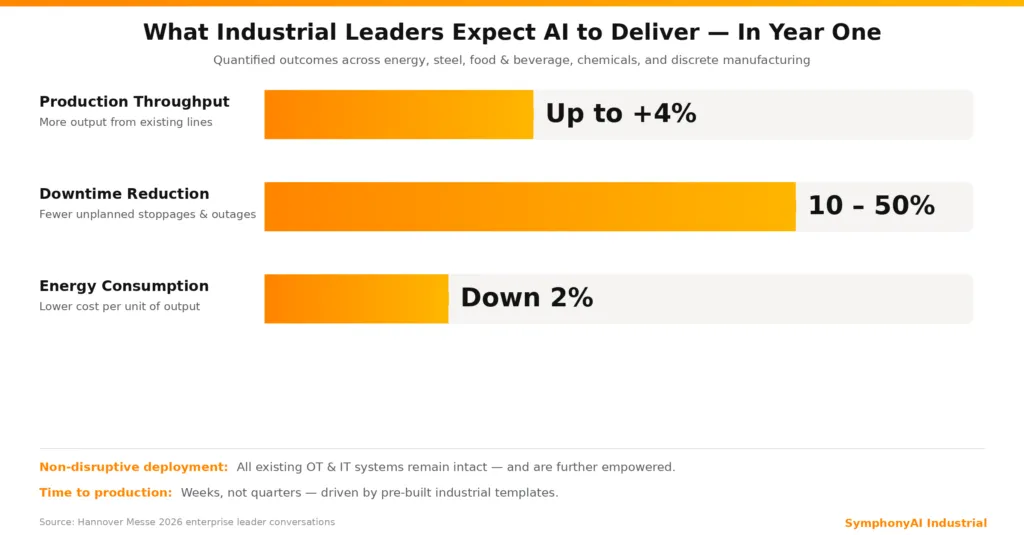
Across sectors — energy technology, steel, chemicals, food and beverage, discrete manufacturing, and packaging — the outcome expectations are specific and quantified. This is not a wishlist; these are the numbers executives are putting in their business cases:
- Up to 4% increase in production throughput
- 10–50% reduction in downtime events
- 2% decrease in overall energy consumption
The mechanism for hitting those numbers is proactive, agentic AI — systems that can predict equipment failures up to 30 days in advance, optimize yield in real time, and surface the right decision to the right person before a problem becomes a crisis. The tools that are winning are those that close the loop from detection to action, rather than stopping at the alert.
The overarching goal, regardless of sector, is margin resilience. AI that improves a single metric in a single plant is interesting. AI that compounds across sites, systems, and decision-makers — integrating seamlessly with Microsoft Copilots that teams are already using — is what executives are committing to.
The Takeaway for Industrial Leaders and Technology Partners
The organizations that are moving fastest share a common approach: they’ve stopped treating AI as a technology project and started treating it as an operational strategy. That means choosing platforms that work with existing infrastructure rather than requiring it to be rebuilt, that deliver domain-specific intelligence rather than generic ML, and that put execution capability in the hands of the people who run the operation — not just the people who analyze it.
For GSI and technology partners, the opportunity is significant — and the window for differentiation is narrowing. Industrial leaders are making platform decisions now. The conversations at Hannover Messe made clear that the bar has moved from “can AI help us?” to “which AI partner can deliver at the speed and scale we need?”
If you’re navigating these questions — for your own operations or on behalf of your clients — we’d welcome the conversation.

As Director of Partnerships at SymphonyAI, I lead initiatives to foster strategic growth through corporate partnership development, leveraging my expertise in business-to-business relationships, cloud AI, and enterprise solutions. My focus remains on building and managing valuable partner ecosystems that drive sustainable innovation and deliver impactful results for customers and stakeholders.