Navigating Tariffs with SymphonyAI IRIS Foundry

Key Takeaways
- Real-Time Tariff Intelligence: IRIS Foundry keeps you updated with real-time tariff changes and integrates them into your procurement strategies instantly.
- Scenario Planning: The platform allows you to simulate tariff impacts and optimize sourcing and logistics routes based on evolving trade policies.
- Optimized Procurement: IRIS Foundry helps evaluate alternative sourcing and logistics paths to reduce the effects of tariffs.
- Integrated Data: It combines internal business data with real-time tariff updates, empowering faster and more informed decision-making.
- Custom Mitigation Strategies: IRIS Foundry enables the creation of tailored applications for strategic tariff mitigation, such as supplier relocation or leveraging trade zones.
Navigating Trade Turmoil
As global markets contend with rapidly evolving trade dynamics, businesses face increasing complexity in managing their operations. The resurgence of aggressive trade policies—most notably the 2025 reinstatement of Section 301 tariffs, often referred to as the “Trump Tariffs”—has created a high-stakes environment. With tariffs on Chinese electronics reaching as high as 125%, procurement strategies, supply chain resilience, and overall operational agility are now more critical than ever. In this landscape of uncertainty, SymphonyAI IRIS Foundry is stepping up as a transformative force, enabling enterprises to navigate these challenges with confidence and clarity.
A New Era for Enterprise Application Development
IRIS Foundry is undergoing an exciting expansion (we will be sharing more on this soon), redefining what’s possible in enterprise application development. More than just a platform, it’s becoming a comprehensive ecosystem for building dynamic applications that are not only deeply functional but also intuitive, engaging, and user-centric. This evolution represents SymphonyAI’s commitment to helping organizations create tools and experiences that users genuinely love—without compromising on power or scalability.
What makes IRIS Foundry stand out is its unprecedented flexibility. It’s built to support a wide range of use cases—from streamlining workflows and enhancing decision-making to delivering real-time insights that drive critical business strategies. One such use case we built on IRIS Foundry recently is tariff implications analysis, to showcase the power & flexibility of the platform.
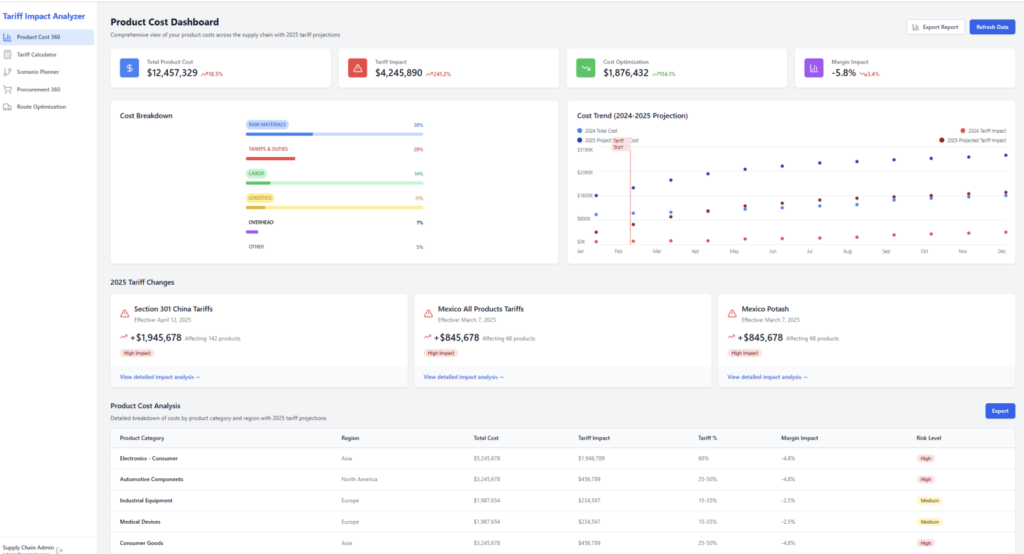
Turning Tariff Volatility into Strategic Insight
As tariff regulations shift and supply chains adapt, IRIS Foundry provides the analytical horsepower and contextual intelligence needed to respond effectively. Whether assessing sourcing alternatives, simulating cost impacts, or optimizing procurement routes, the platform enables organizations to turn complexity into competitive advantage.
Real-Time Tariff Intelligence Meets Enterprise Data
At the heart of this approach lies data integration. SymphonyAI IRIS Foundry enables companies to ingest real-time tariff updates—like the recent April 2025 hike on imports—through its hundreds of built-in data connectors. Whether pulling in U.S. Customs schedules, HTS classification databases, or news-driven policy shifts, Foundry ensures that no change goes unnoticed.
These dynamic updates are then joined with internal production, procurement, and logistics data, creating a single source of truth for tariff impact analysis.
Interactive Tariff Calculators & HTS Intelligence
With tools modeled like the 2025 Tariff Calculator interface as shown in the screenshot, users can:
- Search and input HTS codes
- Specify country of origin and product categories
- Simulate tariff impacts based on real-time Section 301 rates
For example, a $10,000 shipment of electronics from China (HTS Code 8517) now incurs $12,500 in duties—a 125% tariff. Foundry can calculate this instantly and at scale across thousands of SKUs and global trade lanes.

AI-Powered Scenario Planning
Coupled with Data Connectors IRIS Foundry brings the intelligence. Using contextual AI models, IRIS Foundry can perform:
- Cost impact analysis across multiple sourcing and production scenarios
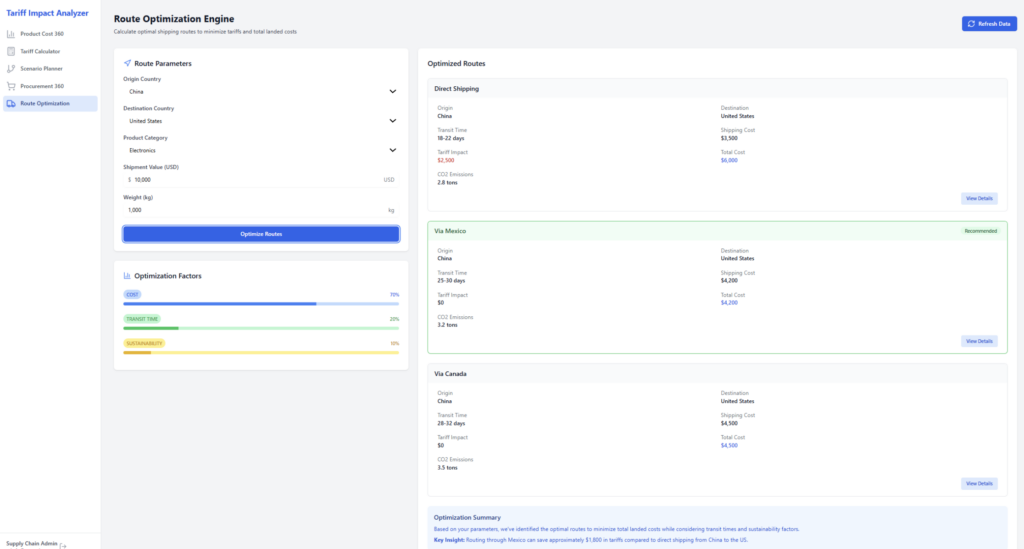
- Route optimization to evaluate alternative logistics paths
- Mitigation strategy recommendations such as tariff exclusions, trade zone use, or supplier relocation
- Procurement simulations to assess financial and operational outcomes under new tariff regimes
This empowers decision-makers with scenario planning tools that are both AI-informed and human-controllable—ensuring alignment across finance, operations, and supply chain teams.

Practical Mitigation Planning
The platform also can offer tactical guidance using custom AI models—like identifying FTZ (Foreign Trade Zones), alternative sourcing regions, or leveraging preferential trade agreements. These strategies aren’t just theoretical; Foundry allows teams to model their feasibility and ROI in real-world terms, helping you act before the next policy takes effect.
Ready for Any Policy Shift
By combining advanced AI, real-time data integration, and a modular, extensible architecture, SymphonyAI IRIS Foundry empowers teams to innovate fast and pivot quickly. Businesses can now build custom applications tailored to their unique challenges, all while maintaining the ability to scale and evolve with changing market conditions. And the best part? These solutions aren’t just powerful—they’re crafted with the end user in mind, ensuring adoption and impact at every level of the organization.
This article "Navigating Tariffs with SymphonyAI IRIS Foundry" by Prateek Kathpal, was originally published on LinkedIn.

Prateek is president of SymphonyAI’s industrial division and executive chairman of SymphonyAI’s enterprise IT division. With over 20 years of technology leadership and extensive experience in the enterprise, telecom, and automotive industries, Prateek brings a unique background in machine learning and AI, product strategy, operations, product technology, engineering, and sales to SymphonyAI. Prateek has extensive experience with highly engineered systems and expertise in B2B and consumer technology, deep learning, cloud virtualization, enterprise software, mobile applications, and information life cycle management. Before joining SymphonyAI, Prateek served as EVP and CTO at Cerence, where he was responsible for Cerence’s technology vision, R&D, and professional services, and rolling out Cerence technology and solutions to more than 65 automotive customers across the world and more than 450 million cars on the road. Before Cerence, Prateek served as general manager of AI and IoT products at View, responsible for leading product strategy, defining and driving product roadmap, and supporting M&A activity to accelerate growth. Before View, he served as VP of product and solution management at Polycom, chief strategy officer at HighQ, and VP of product strategy at Accusoft, which acquired Adeptol, a company Prateek founded. Prateek previously worked for several companies, including EMC, Sapient, Cognizant, and NEC. Prateek holds an MBA and a Bachelor’s of engineering degree in instrumentation and process control.