IRIS Flows
Agents that don’t just recommend—they act
Industrial operations generate more decisions per minute than any team can handle manually. IRIS Flows puts autonomous AI agents to work in your processes—analyzing events, coordinating responses, and executing actions across assets, teams, and facilities in real time. Built on SymphonyAI’s Industrial LLM with 300+ pre-built agents and three modes of governed autonomy, it’s the only agentic AI platform engineered for the complexity of industrial operations.
Agentic AI, proven in production
300+
Pre-built industrial agents. Ready to deploy across manufacturing, energy, and process operations—no build time required.
15%
Reduction in unplanned downtime. Measured outcome across IRIS Flows deployments in smart factory environments.
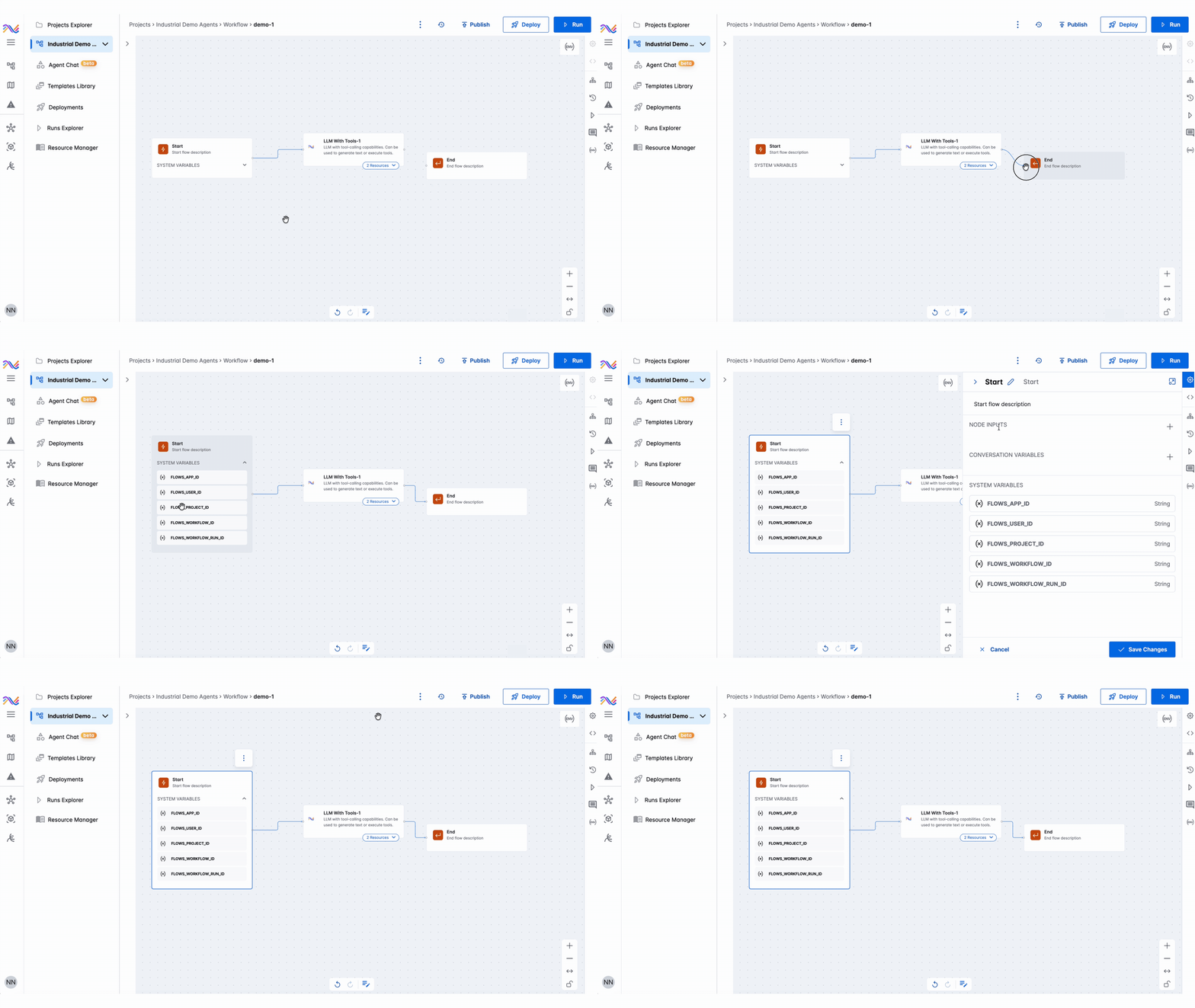
Your operations are too complex for if-then logic
Rule-based systems handle predictable scenarios. Industrial operations aren’t predictable. Equipment behaves differently under different conditions, shifts, and loads—and the interactions between assets, processes, and teams create complexity that static rules can’t navigate. IRIS Flows agents reason from context, not rules. They understand what’s happening, evaluate options, coordinate with other agents and with people, and take action—adapting as conditions change.
Three modes. One governed path to autonomous operations
IRIS Flows meets your operations where they are—and scales autonomy at your pace, with full governance at every step

AI advises. Humans decide.
Agents surface insights, flag anomalies, and recommend actions. Your team reviews and approves every decision. Full visibility, zero autonomy risk. Start here.

AI acts. Humans stay in the loop.
Agents execute defined task classes autonomously—escalating edge cases to human experts. Speed increases. Risk stays managed. Expand agent scope as confidence builds.

AI runs the workflow end to end.
Agents sense, decide, and act across full process loops—continuously optimizing without manual triggers. Human oversight is available but not required for routine operations.
How IRIS Flows works
From a single agent to an enterprise-wide multi-agent network—in four steps


Deploy
Choose from 300+ pre-built agents or design custom agents visually or with natural language—no code required. Agents understand your domain from day one, built on the Industrial LLM.


Connect
Agents plug directly into IRIS Foundry’s unified data layer—accessing real-time sensor data, historian records, maintenance logs, work orders, and enterprise systems simultaneously.


Orchestrate
Multi-agent workflows form dynamically. When a KPI deviation fires, a root cause agent investigates, a scenario agent models outcomes, and a coordination agent routes the right action to the right person or system.


Scale
Multi-agent workflows form dynamically. When a KPI deviation fires, a root cause agent investigates, a scenario agent models outcomes, and a coordination agent routes the right action to the right person or system.
300+ agents. Every critical operation covered.
Pre-built agents are production-ready across the highest-impact use cases in industrial operations

Alarm management and RCA
Intelligent alarm responders triage alerts in real time—filtering noise, identifying root causes, and routing actions to the right operator or system before issues escalate.

Predictive maintenance
Maintenance coordinator agents connect asset health scores from Predictive Asset Intelligence to work order systems—automatically scheduling interventions based on failure probability and operational priority.

Shift intelligence
Shift handover agents capture and contextualize operational events, KPI deviations, and open actions—so every shift starts with a complete, accurate picture of plant status.

Process optimization
Optimization planner agents continuously analyze process conditions, model alternative setpoints, and recommend or execute adjustments to maximize yield, throughput, or energy efficiency.

Safety and compliance
Agents monitor safety-critical conditions, trigger permit-to-work workflows, and coordinate inspection and compliance actions across connected worker systems—maintaining audit trails automatically.

Custom agent creation
Build domain-specific agents using a visual designer or natural language. Agents inherit the Industrial LLM’s contextual understanding of your assets, processes, and data—no training data preparation required.
Agents that run on industrial-grade intelligence
IRIS Flows agents aren’t running on generic AI. Every agent is powered by SymphonyAI’s Industrial LLM—trained on 7+ trillion industrial data points including sensor readings, maintenance records, work orders, and engineering documentation. Agents understand the language, failure modes, and operational logic of your industry before they ever connect to your plant.
Because IRIS Flows sits on IRIS Foundry, agents have access to a fully unified, contextualized data foundation—not isolated data streams. The result is agents that reason with complete situational awareness: real-time OT data, historical trends, asset hierarchies, P&IDs, and enterprise system context, all in one coherent intelligence layer.
Purpose-built agents for every industrial domain
Nine named domain agents, engineered for the specific processes, data types, and decision contexts of each operation
Manufacturing Digital Twin Agent — Teams and M365
Integrates with Microsoft Teams and M365 Copilot via MCP. Plant engineers and managers query asset status, maintenance history, and performance trends in natural language—directly from their existing Microsoft workflow.
Oil and Gas Operations Agent
Monitors upstream and midstream assets, detects process deviations, and coordinates maintenance and safety workflows. Integrates with existing DCS, SCADA, and historian infrastructure without replacement.
Intelligent Factory Agent
Continuously optimizes production across assembly, discrete manufacturing, and mixed operations—coordinating OEE improvement, quality control workflows, and shift intelligence in a single agent loop.
Industrial Data Exploration and Investigation Agent
Empowers engineers and analysts with AI-powered search, root cause analytics, and anomaly detection across vast, complex OT/IT data landscapes.
Smart Utilities Agent
Optimizes energy utility operations with AI-driven forecasting, grid management, and automated trading to enhance efficiency, reliability, and sustainability.
Warranty Claims Agent
Streamlines warranty claims for manufacturers and dealers, leveraging unified data and AI to detect fraud, automate workflows, and improve product quality at scale.
Manufacturing Digital Twin Agent
Unlocks real-time visibility and advanced analytics for manufacturing operations by creating dynamic digital twins of assets, lines, and plants, connecting seamlessly to IRIS Foundry and Azure for scalable insights.
Frontline Worker Agent
Empowers front-line teams with context-driven guidance, automated SOPs, and instant access to expert support, ensuring safety and operational agility at the point of work.
Energy Generation & Distribution Optimization Agent
Enables real-time orchestration and predictive optimization of power generation and distribution, integrating renewables and conventional sources for grid resilience.
Why IRIS Flows, not a generic AI agent platform
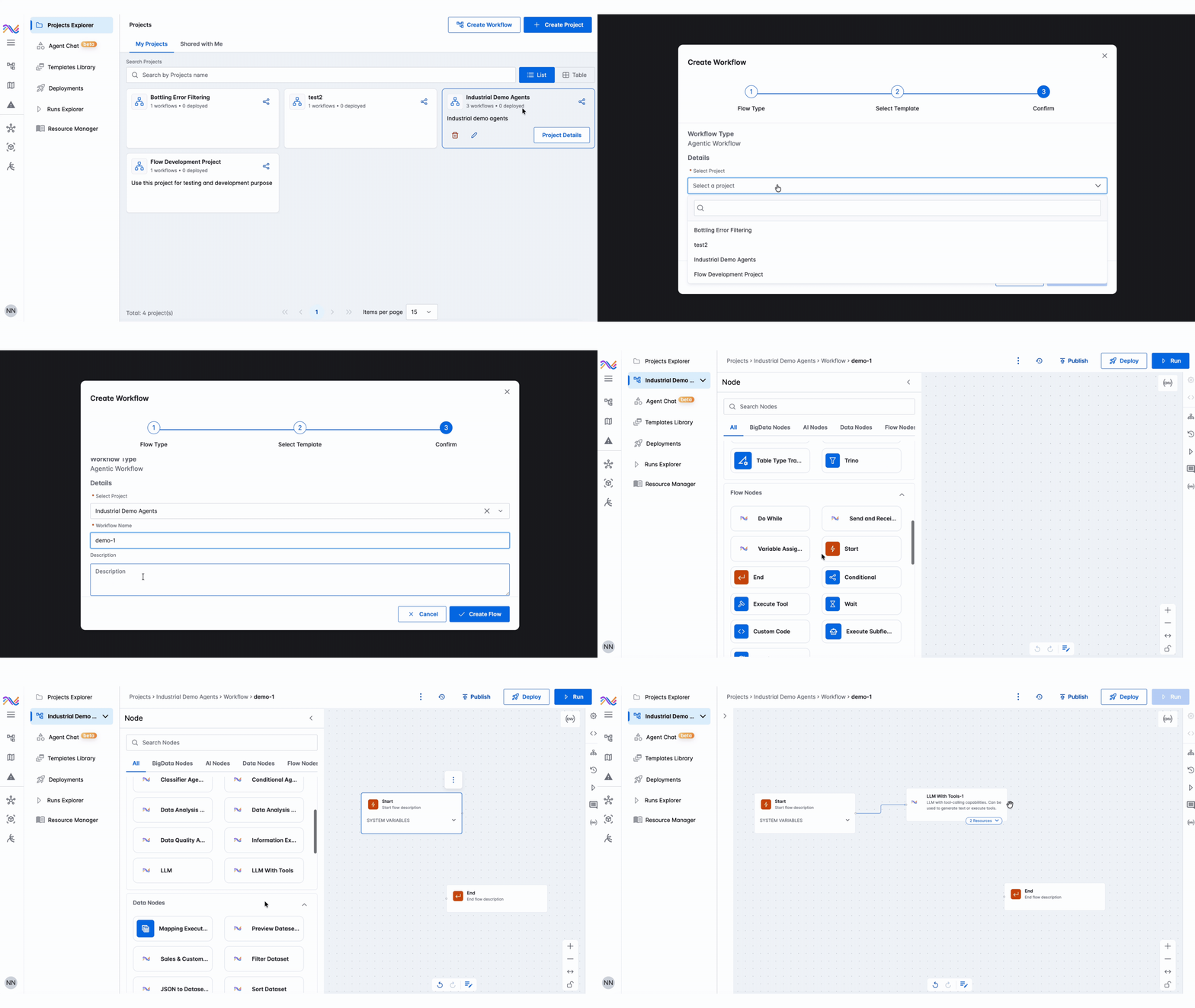
Generic AI agent platforms require extensive setup, custom training, and months of integration work before they understand your operation. IRIS Flows arrives pre-trained on industrial data—with an agent library, domain-specific ontologies, and a data foundation already built. Your team deploys agents in days, not quarters.
Building your own agentic AI in-house means owning the training data, the integration work, the governance framework, and the ongoing model maintenance—indefinitely. IRIS Flows delivers pre-built depth, governed autonomy controls, and continuous model improvements maintained by SymphonyAI’s industrial AI team.
Common Questions
What industrial teams ask before deploying IRIS Flows
Ready to put agents to work in your operation?
Talk to an industrial AI expert and see how IRIS Flows performs in your specific environment.