Winning the Week: How Customer Shopping Behavior Is Shifting from Weekends to Weekdays

An analysis of 1.1 billion transactions across 73 million households reveals a structural realignment in grocery demand — and a critical opportunity for CPG manufacturers and retailers who move first, and move correctly.
Grocery demand is not declining — it is being redistributed. Weekends are losing their grip as the dominant shopping window, and the brands and retailers that recognize this shift earliest will be positioned to capture disproportionate growth.
1.1B
TRANSACTIONS ANALYZED
73M
TRANSACTIONS ANALYZED
3 Yrs
LONGITUDINAL WINDOW
The Weekend Advantage Is Eroding
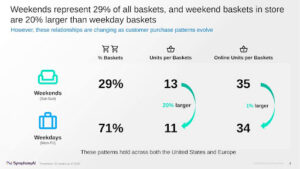
Weekends still account for 29% of all grocery baskets — a significant concentration given just two days of the week. In-store weekend baskets remain 20% larger than their weekday counterparts in units, reflecting the legacy stock-up mission. Online, however, the differential has nearly vanished: weekend e-commerce baskets are just 1% larger than weekday ones, a harbinger of what is coming to physical retail.
What makes this finding strategically important is the trajectory. Weekend basket share has declined 0.7 percentage points over the past three years, with the steepest drop occurring in 2025. This is not noise or seasonal variance — it is a structural trend. Overall grocery traffic simultaneously grew 11% over the same period, meaning the shift is not a sign of weakening demand. Shoppers are simply reorganizing when they buy.
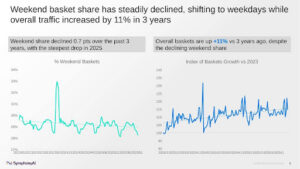
“Overall grocery traffic grew 11% in three years, even as weekend share declined. The category is healthy — but the calendar is changing.”
E-Commerce Is Accelerating the Shift
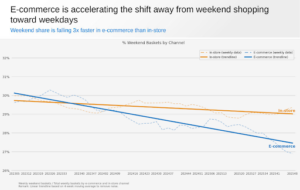
The decline in weekend shopping is not uniform across channels. In e-commerce, weekend basket share is falling at three times the rate observed in physical stores — a finding that carries material implications for category planning, promotional timing, and digital shelf strategy.
The logic is intuitive in hindsight: online grocery removes the friction that once made weekday shopping impractical. When a household does not need to commute to a store, park, and navigate a shopping floor, the planning horizon collapses. Replenishment happens on Tuesday evening. Quick additions to a cart happen Wednesday morning. The weekly big shop fragments into a series of smaller, more frequent digital interactions spread across the week.
For CPG manufacturers, this creates a need to rethink where and when digital investments pay off. Trade promotions anchored to the weekend window are losing audience. Content and search strategies optimized for Friday-afternoon grocery browsing will increasingly miss where shoppers are actually active.
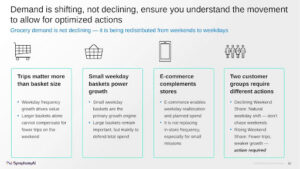
Trips Matter More Than Basket Size
In the relationship between trips and spending, the data reinforces a clear conclusion: it is trip frequency, not basket size, that drives household spending growth.
When SymphonyAI segmented repeat customers by how their weekend-versus-weekday mix changed year over year, a clear pattern emerged. Customers shifting spend into weekdays grew their total annual spend by nearly +5.9%. Customers migrating toward weekends saw spending decline by more than 10%, despite larger individual baskets, because they were making fewer trips overall. It is a function of where the trips are being lost.
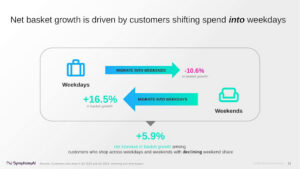
The mechanism is straightforward: losing weekday trips while maintaining the larger weekend trips is a net decline in engagement — regardless of how large the remaining baskets are. The implications for retention strategy are significant. Keeping customers active across multiple days of the week is not just a frequency play; it is a spending growth play.
Small Baskets Are the Growth Engine
Understanding which missions are driving weekday growth is essential for both category strategy and trade planning. The data points to small in-store baskets — the quick top-up, the meal component, the impulse replenishment — as the dominant growth driver for weekday-shifting customers.
Small in-store baskets contribute +5.35% to net basket growth among customers increasing their weekday shopping frequency. Large in-store baskets, while declining slightly (−0.63%), are fully offset by this small-basket growth. E-commerce complements the pattern, growing across all basket sizes — with large e-commerce baskets leading at +0.11% — but digital channels are not replacing in-store frequency. They are enabling a reallocation of planned spend, particularly for heavier categories.
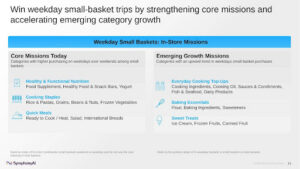
The category-level data reveals clear priority areas for manufacturers. Three mission clusters dominate weekday small-basket activity today.
The emerging categories represent a particular opportunity: they are growing their share of weekday small-basket purchases on a positive trajectory, meaning early investment in weekday-anchored promotions, digital search visibility, and store adjacency will compound over time.
Two Customer Groups, Two Different Strategies
Not every shopper is making this transition at the same pace — or in the same direction. The research identifies two meaningfully distinct segments among dual-channel customers (those who shop on both weekdays and weekends), and the prescription for each is different.
The Weekday-Shifting segment (39% of customers) is already generating more small in-store trips during the week, growing their baskets organically. The strategic priority here is to reinforce — win their weekday missions, stay relevant in the categories they shop, and ensure visibility at the moment of top-up intent.
The Weekend-Shifting segment (36% of customers) is moving in the opposite direction, and the data shows it costs them dearly: small store baskets decline by 5.04%, with medium and large formats also contracting. E-commerce growth (+0.05%) is far too small to offset these losses. For retailers and CPG brands, this group represents a re-engagement challenge — these shoppers are consolidating or taking trips to the competition. Retailers and brands need to thwart the weekday trip decline, while continuing to maximize the large weekend trips that remain.
What This Means for CPG Manufacturers
The practical implications of this research span promotion strategy, assortment, digital investment, and customer segmentation. Here is how leading CPG teams are beginning to operationalize the findings:
Shift Promotional Windows
Rebalance trade promotion calendars toward mid-week peaks. Thursday and Friday digital promotions reach customers before the last-minute weekend decision, not after.
Prioritize Top-Up Pack Formats
Small-basket trips favor convenience pack sizes. Brands with strong weekday category presence should optimize SKU architecture for units purchased one or two at a time.
The shift from weekend to weekday shopping is not a temporary behavioral quirk. The three-year trend line, the channel dynamics in e-commerce, and the customer-level spending data all point to a structural realignment that will continue. The window to build weekday relevance before it becomes table stakes is narrowing.
Want to explore what these trends mean for your specific categories and customers?
SymphonyAI’s CPG Insights Coaches are available to walk your team through the findings, apply them to your category portfolio, and connect you with the right analytics resources. Reach out to your SymphonyAI account team or visit symphonyai.com/retail-cpg/get-started to connect with an Insights Coach.

Josh McCann brings extensive experience in retail leadership, strategic pricing, and category management. At SymphonyAI, he leverages deep industry knowledge and advanced analytics to help clients drive performance and operational efficiency. With a strong background in translating strategy into action, Josh is focused on delivering measurable business outcomes through innovation and data-driven insights. He holds a degree from the USC Marshall School of Business and is based in Eagle, Idaho.