Going beyond continuous compliance with Always-on Compliance

Always-on Compliance™ is the next evolution in the continuous compliance model
The next stage of financial crime prevention can be defined in one sentence: A self-updating continuous compliance ecosystem that is powered by predictive, generative, and agentic AI, and which adapts in real time to regulatory change, emerging threats, and operational context.
This is Always-on Compliance from SymphonyAI.
It is a model where detection logic, controls, workflows, and risk scoring refresh dynamically as the world changes. In this environment, compliance is no longer a batch process, a quarterly tuning cycle, or a project-based upgrade. This approach to continuous compliance helps it becomes a living system.
For years, industry progress has been constrained by static rules engines, fragmented tech stacks, long lead times for regulatory updates, IT dependences, and manual model governance. But with today’s advances in agentic AI and platforms that are endlessly learning (‘always-on’), financial institutions finally have the technology to reach the next stage in continuous compliance with Symphony Risk Intelligence (SRI) built expressly for this purpose.
Why Always-on Compliance™, and why now?
A century ago, a financial organization’s approach to risk was relatively straightforward and only really had to extend as far as the next bank. Every customer was local and, when a transaction occurred, the risk would travel in a straight line between the buyer and the seller. A lot has changed since then.
Financial crime has been evolving more quickly than ever with the rise of instant payments, globalized ecommerce, and cryptocurrency networks. More recently, AI has enabled criminals to further accelerate the potential risks. Unfortunately, the compliance processes meant to combat this remain slow, episodic, and manual. Traditional rules engines, often updated only periodically, leave institutions chasing shadows by reacting to threats that have already moved on.
To compound the problem, regulatory expectations now centre on agility, explainability, and consistency. The expectation is for banks to operationalize new rules immediately, not months later after IT has found the time in their busy schedule.
The solution is Always-on Compliance, which closes this gap by enabling:
- Real-time regulatory responsiveness
- Continuous model improvement and validation
- Automated governance and auditability
- Dynamic threat enrichment (shared across customers and channels)
- Scalable growth without proportional cost and headcount increases
With the right infrastructure, compliance becomes not only proactive but self-optimizing.
What does Always-on Compliance require?
Achieving Always-on Compliance requires three foundational capabilities, each deeply embedded in Symphony Risk Intelligence:
1. Dynamic detection logic that updates continuously
For Always-on Compliance to work, detection models must evolve with every new insight. Agentic AI solves this by automatically ingesting regulatory updates, monitoring risk signals, and refreshing rules or models as needed.
SRI’s AI-led detection capabilities support this through self-serve risk models, anomaly detection, and continuous tuning.
2. Continuously enriched data that improves detection
Institutions uncover new typologies every day. In a static model, this knowledge remains siloed. With Always-on Compliance, these insights feed directly into an enterprise threat library, which naturally improves detection for every customer and workflow.
SRI creates a ‘single pane of glass’, consolidating insights from AML, sanctions, fraud, and KYC to build a complete view of potential threats. This unified view is strengthened by shared ontologies that standardize entities, behaviours, relationships, and typologies across risk domains. This ensures that every insight enriches the same structured intelligence layer.
3. End-to-end agentic workflows that automate the full life cycle
Today, AI can automate much more than simple triage. Autonomous agents can refresh rules, gather data, perform investigations, and much more, with humans providing oversight where judgment is required (such as complex cases that require nuanced expertise). It is important to note that it isn’t just one agent but many, with each Symphony Agent taking on a separate role such as advising on policies and processes that require changing through to updating agentic workflows and AI models quickly, without the need for IT dependencies.
Again, the use of ontologies is important. These workflows rely on them to make sure that agents interpret data and regulatory concepts consistently, enabling them to collaborate coherently across the full compliance lifecycle.
How Symphony Risk Intelligence powers Always-on Compliance™
SRI was built explicitly to allow intelligence and continuous compliance. Several of its capabilities make it the natural foundation for Always-on Compliance:
- Evergreen, cloud-native architecture - Because of its evergreen, cloud-native SaaS architecture, SRI ensures institutions are always on the latest AI innovations with zero-effort upgrades, which is an essential feature for true continuous compliance.
- Three types of AI working together in one platform - SRI combines three categories of AI – predictive, generative, and agentic - to automate detection and decisioning, enabling constant optimization across all compliance workflows. As mentioned previously, underpinning this is an ontology-driven data structure that ensures every model and agent operates in a consistent manner regarding risk categories, customer attributes, and behavioral patterns.
- Agentic AI that responds instantly to change - Symphony Agents allow institutions to adapt to new regulations in days, not months. To ensure maximum agility, agents can be re-configured and redeployed instantly, bringing Always-on Compliance into practice.
Again, ontologies play a crucial role. By mapping new regulatory concepts to existing workflows automatically, everything moves a lot faster than traditional methods and with complete consistency.
- Integrated model governance - A primary focus of Always-on Compliance is continuous monitoring. With this in mind, SRI’s Symphony Detection includes drift detection, champion–challenger testing, and full MLOps governance.
In this case, ontologies guarantee that governance processes compare like-for-like concepts across models, maintaining that transparency and consistency required by regulators.
The 50/50 Compliance Model
The idea of Always-on Compliance is not to replace human judgement, but to amplify it. The 50/50 Compliance Model is a great way for institutions to get hands on with this idea, using AI to automate roughly half of an organization’s operational workload while enabling humans to focus on the highest-value tasks.
Taken as a whole, these capabilities create a system that is not only self-updating but self-improving, which has wide-ranging positive ramifications across an organization.
How Always-on Compliance™ continuously evolves
So how exactly do these positive outcomes occur? How does Always-on Compliance evolve on a constant basis to provide the continuous compliance that organizations are after?
It’s perhaps easiest to lay this out below in the form of a five-step guide, which showcase how SRI, once implemented, generates a reinforcing cycle of improvement that powers Always-on Compliance.
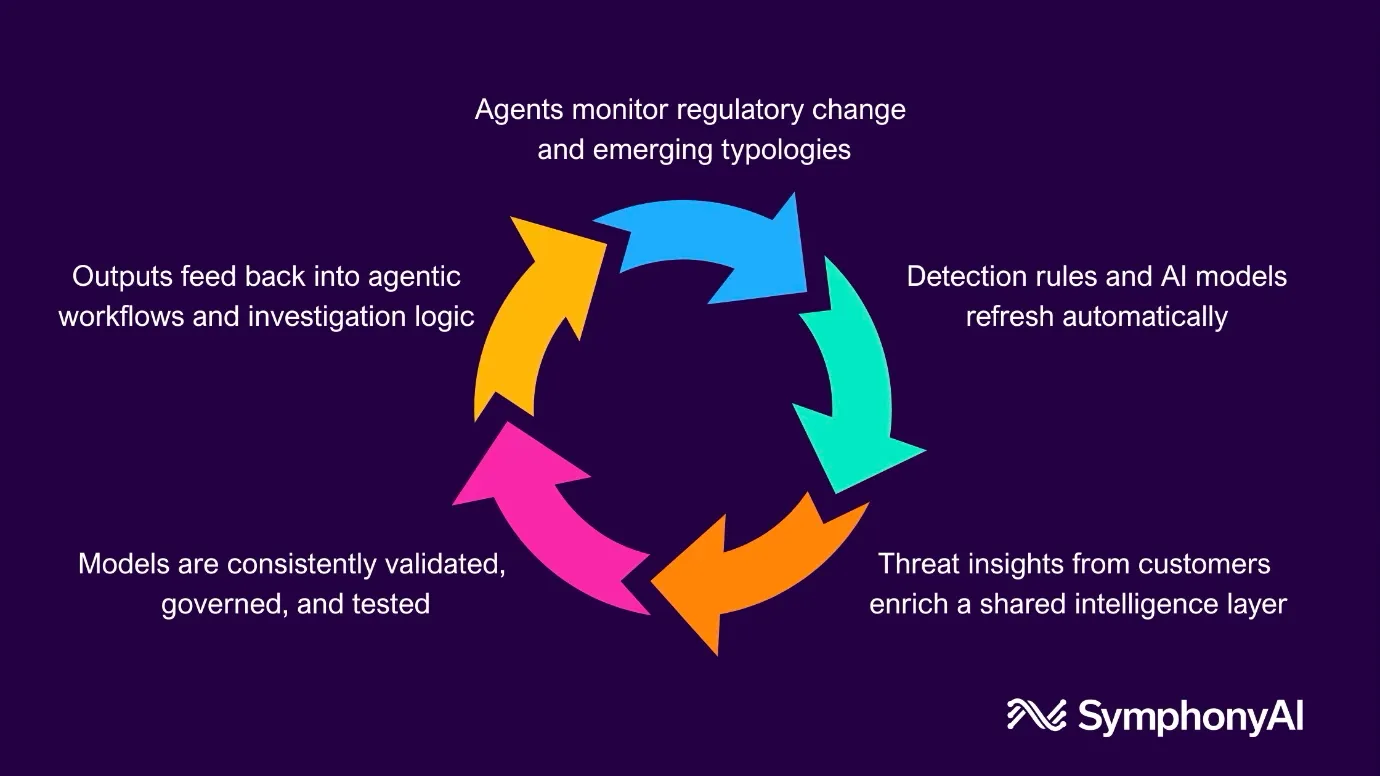
As seen in the image above, every action feeds into one another:
- Agents monitor regulatory change and emerging typologies
- Detection rules and AI models refresh automatically
- Threat insights from customers enrich a shared intelligence layer
- Models are continuously validated, governed, and tested
- Outputs feed back into agentic workflows and investigation logic
This produces the continuous compliance that organizations have been striving to enact. Always-on Compliance provides a living compliance ecosystem that becomes more accurate, more contextual, and more efficient over time, with SRI operationalizing this loop through integrated detection, investigation, case management, model governance, and agent orchestration.
Ontologies ensure that this ecosystem evolves in a logical way by maintaining a stable framework as new threats, data, and typologies emerge.
Taking your organization to the next level
Once an institution has invested in Symphony Risk Intelligence and is getting the most out of Always-on Compliance, there are a few other benefits that result, creating a major shift that reshapes how your organization operates.
A forward-thinking CRO can understand the potential immediately with compliance transforming from a cost centre into a growth engine. The organization will have a far more comprehensive dataset and understanding of their customers, which can be used in many different ways, but automations will allow institutions to expand products, jurisdictions, and customer segments without having to increase headcount.
Even without that increasing headcount, human expertise becomes more valuable, not less. By removing the burden of manual work, AI ensures investigators focus on nuance, judgment, and risk interpretation, which are exactly the skills regulators value most. As explained previously, this plays into the 50/50 Compliance Model, but the numbers on either side can be changed to suit your business needs (40/60, 60/40, etc.), delivering far greater returns on investment than have been previously seen.
Finally, supervisors already favour transparent, explainable, audit-ready agentic AI. Always-on Compliance gives them exactly what they want in the form of consistency, speed, and clarity, helping to promote your organization as trustworthy to customers.
Why this moment matters
The industry has spent decades fighting financial crime with tools designed for a slower era. Continuous compliance was the start and Always-on Compliance takes this idea even further.
It is not simply an evolution of existing practices but a complete transformation of managing risk. Always-on Compliance gives institutions the freedom to grow, the agility to adapt, and the intelligence to stay ahead of not just the criminals, but competitors as well.
SRI turns this vision into reality. By unifying data, detection, investigations, and agentic automation into a single platform, and structuring them through shared ontologies,SRI creates a continuously learning environment capable of powering the next decade of financial crime prevention.
Related resources
Perpetual KYC vs periodic review: The case for Always-on Compliance™
Re-engineering the Risk-based approach with agentic AI - webinar
Re-engineering the risk-based approach with agentic AI - white paper
Whitepaper: The New Financial Crime Ecosystem
Reinventing the compliance operating model
From Reactive to Proactive: Managing Regulatory Compliance with AI
Command and Control Rewired: Agentic AI in Anti-Financial Crime
Learn more about Symphony Risk Intelligence
Contact us to find out more about Symphony Risk Intelligence and Always-on Compliance and to receive a personalized demo.

Jason has a wealth of experience in senior IT leadership roles over 30 years of working in Financial Services IT where he has built an extensive network both within the global banking and FinTech industries. Jason joined SymphonyAI Financial Services in December 2023 as Head of Strategy and Innovation based in London. Jason was most recently at UBS, where he was Managing Director & Head of Group compliance, Regulatory and Governance (GCRG) Technology, with responsibility for approx. 700 staff, as well as IT strategy, FinTech and delivery of Financial Crime Prevention (FCP), Employee Conduct and non-financial Risk, spanning all of UBS’s businesses. Prior to UBS, Jason spent almost 10 years at Credit Suisse, where he held a number of leadership positions, including Head of Compliance Technology, Head of IT for the Strategic Resolution Unit and a number of positions within Equities and Prime Services technology. Jason was at Bank of America Merrill Lynch for 12 years before Credit Suisse in roles ranging from operations & finance technology to front-office Equity Risk & Prime Services. He started his career as a Developer at Wilco International and ING Barings. Jason holds a Bachelor of Engineering degree in Mechanical Engineering with Business Management from the University of Strathclyde. Jason is married with 2 daughters and lives in Hertfordshire.