Eliminating 90% of manual work in FinCrime compliance

Financial crime compliance teams are under increasing operational pressure.
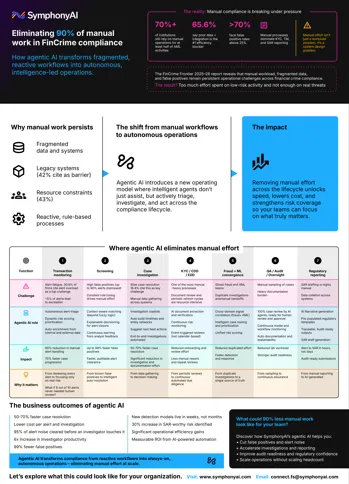
More than 70% of financial institutions still rely on manual operations for at least half of their AML activities. Rising alert volumes, fragmented systems, false positives, and growing regulatory expectations are forcing organizations to spend too much time on manual, low-value activity and not enough on real risk.
This is a clear indication that traditional, reactive compliance operating models are becoming unsustainable.
Advances in agentic AI are creating a new opportunity to transform financial crime operations. Instead of relying on disconnected workflows, repetitive reviews, and manual investigations, financial institutions can now move toward always-on, autonomous operations that continuously triage, investigate, prioritize, and support decision-making across the compliance lifecycle.
This infographic explores:
- Why manual effort continues to persist across financial crime compliance
- Where operational bottlenecks are most common across AML, sanctions, KYC, investigations, QA, and reporting
- How agentic AI can eliminate up to 90% of manual effort across the compliance lifecycle
- The measurable business outcomes organizations are beginning to achieve through intelligent automation
Drawing on findings from the FinCrime Frontier 2025–26 report and SymphonyAI’s experience in AI-driven financial crime prevention, the infographic highlights how institutions can reduce manual workload, improve operational efficiency, strengthen audit readiness, and accelerate investigations without scaling headcount.
Download the full infographic to explore how agentic AI is reshaping financial crime compliance.
Related resources
The Sanctions Intelligence Shift (White paper)
90% reduction in manual effort: The power of AI agents in sanctions compliance (Case study)
How AI agents reduce AML investigation time by 60% (Blog)
Agentic AI, Data, & Financial Crime Control (Blog)
Re-engineering the Risk-Based Approach in AML compliance (Webinar)
Re-engineering the Risk-Based Approach with agentic AI (White paper)

Alison Dvorak is a senior marketing leader at SymphonyAI focused on enterprise and vertical AI. She brings over a decade of experience across startups and large global organizations. Her work centers on how technology shows up in real workflows and real decisions. She is particularly interested in the human side of AI—how it changes the pace and shape of everyday work.