Agentic AI will redefine industrial operations — and SymphonyAI is building the future today
Industrial operations are entering a fundamental transformation. For decades, manufacturers, energy operators, and asset-intensive organizations have worked to digitize their environments—connecting equipment, unifying data sources, deploying predictive models, and modernizing workflows. Yet despite enormous investments, most organizations still struggle to translate their data into action. Massive volumes of real-time sensor telemetry, maintenance logs, alarms, documents, and process data remain siloed and underutilized. The workforce is stretched thin, expertise is retiring, and operations are increasingly too complex for traditional automation to manage reliably.
The challenge is not a lack of data. It is a lack of intelligence that can understand the data, reason across systems, and take meaningful action at speed.
This is why the industrial world is shifting toward Agentic AI—a new class of intelligent systems capable of perceiving context, understanding goals, collaborating with other agents, and acting autonomously as digital teammates within the plant environment.
At SymphonyAI, we have built the platform that makes this possible: IRIS Flows, the world’s most advanced agentic AI environment for industrial operations.
The Promise and Pressure Driving Agentic AI
Industrial teams are facing growing pressure to operate smarter, faster, and with greater resilience. Downtime is more expensive. Energy usage is more scrutinized. Workforce shortages are rising. Safety requirements are intensifying. At the same time, plants are becoming instrumented with thousands of sensors, generating millions of data points every minute—far beyond what humans can interpret or respond to.
Traditional automation cannot solve this alone. Rules-based systems require constant manual upkeep. Dashboards still depend on someone noticing a problem and choosing what to do next. Even conventional AI models remain isolated from the full operational picture, lacking the context and connectivity required to make holistic decisions.
What’s needed is intelligence that doesn’t just surface insights—but understands the full operational environment and acts with purpose.
Agentic AI represents this next step. It transforms AI from a passive analytical assistant into an active, collaborative entity capable of decision-making, execution, and continuous learning.
IRIS Flows is the industrial execution of this vision.
IRIS Flows: A New Frontier for Autonomous Industrial Agents
IRIS Flows is not just a feature. It is a new architectural layer that allows industrial organizations to build, deploy, and orchestrate intelligent agents—digital workers capable of handling operational responsibilities with reliability, consistency, and speed. These agents are built on top of the unified, contextual, real-time intelligence of IRIS Foundry’s DataOps, Industrial LLM, and Knowledge Graph/Cortex, giving them an understanding of industrial context that generic AI systems simply cannot achieve.
In IRIS Flows, agents do not act as isolated bots. They operate within an orchestration framework where they can collaborate, share information, and jointly solve operational challenges across assets, processes, and teams. The system is designed so that multiple agents can work together toward a shared objective—whether managing equipment health, optimizing production, ensuring safety compliance, or coordinating complex maintenance activities.
This transforms operations from reactive and manual into proactive and autonomous.
A Platform Built for the Realities of Industrial Complexity
What makes IRIS Flows uniquely powerful is the intelligence and structure that sits beneath it. SymphonyAI designed IRIS Flows to function not simply as an application, but as an execution layer on top of a deeply contextualized industrial data foundation. The strength of IRIS Foundry—its semantic industrial knowledge graph, unified namespace, and AI-ready DataOps architecture—provides the basis that allows IRIS Flows agents to reason and act with determinism rather than guesswork.
The industrial knowledge graph in IRIS Foundry continuously connects and updates relationships between assets, documents, time-series data, P&IDs, alarms, engineering drawings, work orders, 3D models, safety instructions, maintenance logs, and process histories. It creates a living, navigable representation of the plant—one that is always aligned with industrial semantics, operational hierarchies, and equipment relationships.
This gives agents a “mental model” of operations. They understand not just sensor readings, but how those readings relate to upstream production steps, downstream quality outcomes, safety implications, and maintenance procedures. When an agent in IRIS Flows analyzes an event, it does so with the full context of how that event affects and is affected by the rest of the operation.
This grounding enables agents to provide accurate, trustable decisions—something generic LLMs cannot achieve without this deterministic industrial context.
Agents That Understand, Reason, and Act
Unlike traditional automation, agents in IRIS Flows can perform tasks that require judgment, cross-functional awareness, and real-time adaptation. An agent can interpret an anomaly not just as an out-of-range value, but as a potential early-stage failure when correlated with pressure spikes, historical patterns, and maintenance records. An agent can read a 50-page vendor manual, extract relevant procedures, and guide a frontline worker through the correct steps using natural language. An agent can evaluate the cascading effect of an equipment deviation on KPIs like throughput, energy usage, or quality, and generate insights in seconds.
These capabilities are possible because IRIS Flows agents are powered by SymphonyAI’s Industrial LLM and multimodal intelligence engine, designed to work across:
- Sensor and time-series data
- Documents, manuals, and SOPs
- Engineering drawings and P&IDs
- 3D twins and visual data
- Maintenance systems
- Process data and operational KPIs
- Safety systems and EHS information
- Connected worker tasks and workflows
This multimodal intelligence allows agents to function not as “bots,” but as digital subject-matter experts capable of continuous learning and contextual reasoning.
Build Your Own Digital Workforce—Without Writing Code
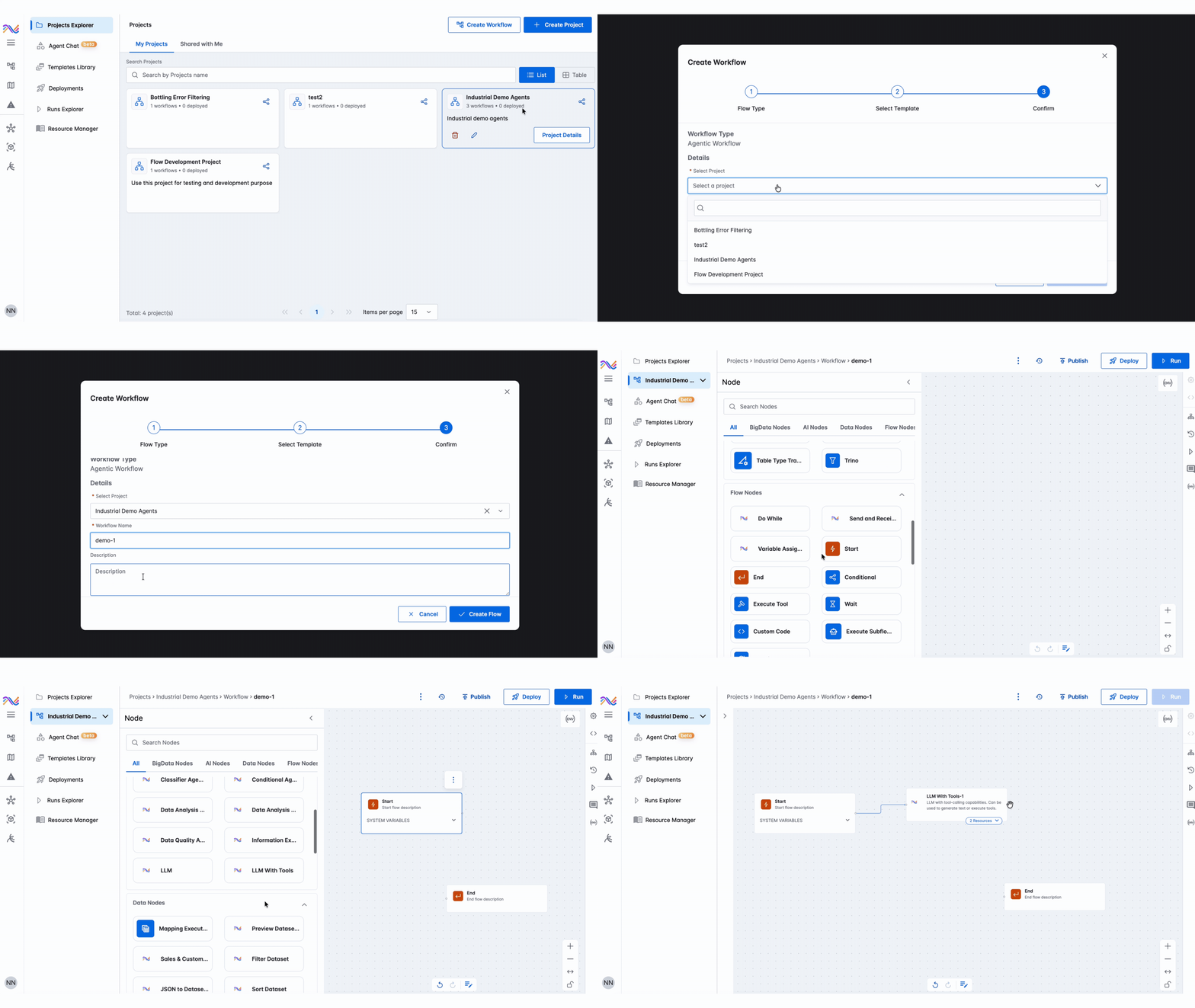
One of the core principles behind IRIS Flows is ease of creation and adoption. Industrial teams should not need IT teams or data scientists to build intelligent agents. With Flows, anyone can spin up an agent by simply describing its responsibility in natural language, connecting it to relevant data sources, and defining guardrails for how it should behave.
The visual editor allows teams to design end-to-end workflows, chain multiple agents together, incorporate condition logic, connect to external systems, and embed human approval loops when needed. This allows organizations to build a digital workforce in the same way they design their human workforce: by defining roles, responsibilities, collaboration patterns, and escalation paths.
SymphonyAI includes a growing library of prebuilt agents, covering common industrial responsibilities such as anomaly detection, alarm management, energy optimization, root cause analysis, quality inspection guidance, predictive maintenance workflow generation, and shift reporting. These agents can be deployed immediately or customized to fit any plant’s unique processes.
A New Paradigm: Multi-Agent Collaboration
The real power of IRIS Flows lies not in individual agents, but in the orchestration of multiple agents working in synchrony. Industrial operations are inherently interconnected. When equipment performance dips, maintenance, operations, production, engineering, and quality are all impacted. Traditional automation cannot manage these cross-functional dynamics.
In IRIS Flows, agents collaborate seamlessly. A single anomaly detected by a sensor agent can trigger a chain of coordinated activity:
- A reasoning agent determines likely causes by cross-referencing telemetry, maintenance history, and engineering constraints.
- A maintenance agent reviews the risk and decides whether a work order should be created.
- A connected worker agent generates an actionable SOP-driven workflow based on asset conditions.
- A performance agent evaluates the operational impact on KPIs and recommends process adjustments.
- A knowledge agent surfaces relevant documents, procedures, or historical resolutions.
- A reporting agent records the event and updates organizational learning for future predictions.
This ecosystem mirrors how human teams collaborate, but operates with far greater speed, consistency, and scalability.
Human-in-the-Loop: Autonomy with Governance
Agentic AI is not about removing humans from the equation. It’s about removing the friction, delay, and variability that limit operational excellence. IRIS Flows is designed for governed autonomy. Organizations can choose how much decision-making authority to grant agents, ensuring alignment with safety requirements, compliance standards, and cultural expectations.
Flows supports assistive, augmented, and fully autonomous modes. In assistive mode, agents provide insights, recommendations, and information, while humans remain in full control. In augmented mode, agents can prepare actions and trigger workflows, but require human approval. In autonomous mode, agents perform well-defined tasks within pre-approved boundaries, operating continuously and reliably even when human teams are overloaded.
This flexibility makes IRIS Flows adaptable across industries, maturity levels, and risk profiles.
The Future of Industrial Operations Is Agentic
Agentic AI represents the moment where industrial intelligence becomes actionable, autonomous, and self-improving. It is the shift from “assist me” to “work with me” to “work for me.”
With IRIS Flows, SymphonyAI has created the first industrial-grade platform for this future—a platform where AI agents can think, collaborate, and act with the same clarity and context as a seasoned engineer, at speeds no human team can match.
This is more than efficiency. It is a new operating model for industry—one where operations become continuously learning ecosystems, where knowledge is captured and scaled automatically, where downtime is prevented rather than reacted to, and where human teams are empowered to focus on engineering, innovation, and strategic improvement rather than firefighting.
Ready to unlock the next era of industrial intelligence? Contact SymphonyAI Industrial today to see how IRIS Flows can transform your operations with agentic AI.